Did you know that mitochondrial dysfunction could be a hidden factor in obesity? Recent research from UC San Diego reveals that fragmented mitochondria in white fat cells significantly reduce the body’s ability to burn fat. This discovery sheds light on why some individuals struggle with weight loss, even when following strict diets and exercise routines.
The study highlights the role of the RalA protein, which suppresses energy expenditure when activated. In mouse studies, high-fat diets over 8-12 weeks led to mitochondrial fragmentation, mirroring findings in human tissue analysis. This breakthrough suggests that targeting mitochondrial health could open new doors for effective obesity therapies.
Understanding the connection between mitochondrial health and metabolism is crucial. By optimizing these cellular powerhouses, it might be possible to enhance fat-burning efficiency and support sustainable weight loss. Could this be the key to tackling one of the most persistent health challenges of our time?
Key Takeaways
- Mitochondrial dysfunction is linked to reduced fat-burning capacity.
- The RalA protein plays a critical role in suppressing energy expenditure.
- High-fat diets cause mitochondrial fragmentation in both mice and humans.
- Targeting mitochondrial health could lead to innovative obesity treatments.
- Optimizing cellular energy production may support effective weight management.
Introduction: The Role of Mitochondria in Weight Loss
Obesity significantly alters the structure and function of fat cells. White adipose tissue, which stores energy and regulates hormones, becomes dysfunctional in this condition. This dysfunction is linked to chronic inflammation and metabolic disorders.
In obesity, fat cells expand, leading to mitochondrial fragmentation. This reduces their ability to burn energy efficiently. The result is a cycle of reduced energy expenditure and increased fat storage.

Chronic inflammation in adipose tissue is a key driver of insulin resistance. This condition makes it harder for cells to respond to insulin, further disrupting metabolism. Over 40% of U.S. adults are affected by obesity, according to the WHO.
Understanding mitochondrial dynamics is crucial. These cellular powerhouses influence energy expenditure and fat-burning capacity. Targeting their health could pave the way for innovative treatments.
| Key Factor | Impact on Obesity |
|---|---|
| White Adipose Tissue | Expands, leading to inflammation |
| Mitochondrial Fragmentation | Reduces energy-burning capacity |
| Insulin Resistance | Disrupts metabolic processes |
Dietary and therapeutic interventions are being explored to address these issues. By improving mitochondrial function, it may be possible to enhance fat-burning efficiency and combat obesity effectively.
Understanding Mitochondria: The Powerhouse of Your Cells
Mitochondria are often called the powerhouses of cells for a reason. These tiny structures generate ATP, the primary energy currency of cells. Without them, cells wouldn’t have the fuel needed to function properly.
In healthy cells, mitochondria constantly undergo fusion and fission. This balance ensures they remain efficient and adaptable. However, obesity disrupts this process, leading to excessive fission and reduced energy production.

What Are Mitochondria?
Mitochondria are membrane-bound organelles found in most cells. They convert nutrients into energy through a process called oxidative phosphorylation. This process is vital for maintaining cellular functions and overall metabolism.
Interestingly, mitochondrial activity varies between fat cells. Subcutaneous fat, found just under the skin, has more active mitochondria compared to visceral fat, which surrounds internal organs. This difference impacts how efficiently fat is burned.
How Mitochondria Affect Metabolism
In obesity, mitochondrial fragmentation becomes excessive. This is driven by the activation of the RalA protein, which disrupts the balance between fusion and fission. Studies show this reduces fat oxidation capacity by up to 60% in mouse models.
Human and mouse studies reveal similar patterns. Both show that mitochondrial dysfunction in fat cells leads to reduced energy expenditure. This highlights the importance of maintaining mitochondrial health for metabolic efficiency.
| Mitochondrial Process | Impact on Cells |
|---|---|
| Fusion | Promotes efficiency and adaptability |
| Fission | Excessive fission reduces energy production |
| RalA Activation | Disrupts mitochondrial balance |
Understanding these processes is crucial. By targeting mitochondrial health, it may be possible to improve energy production and combat metabolic disorders effectively.
The Science Behind Mitochondria and Obesity
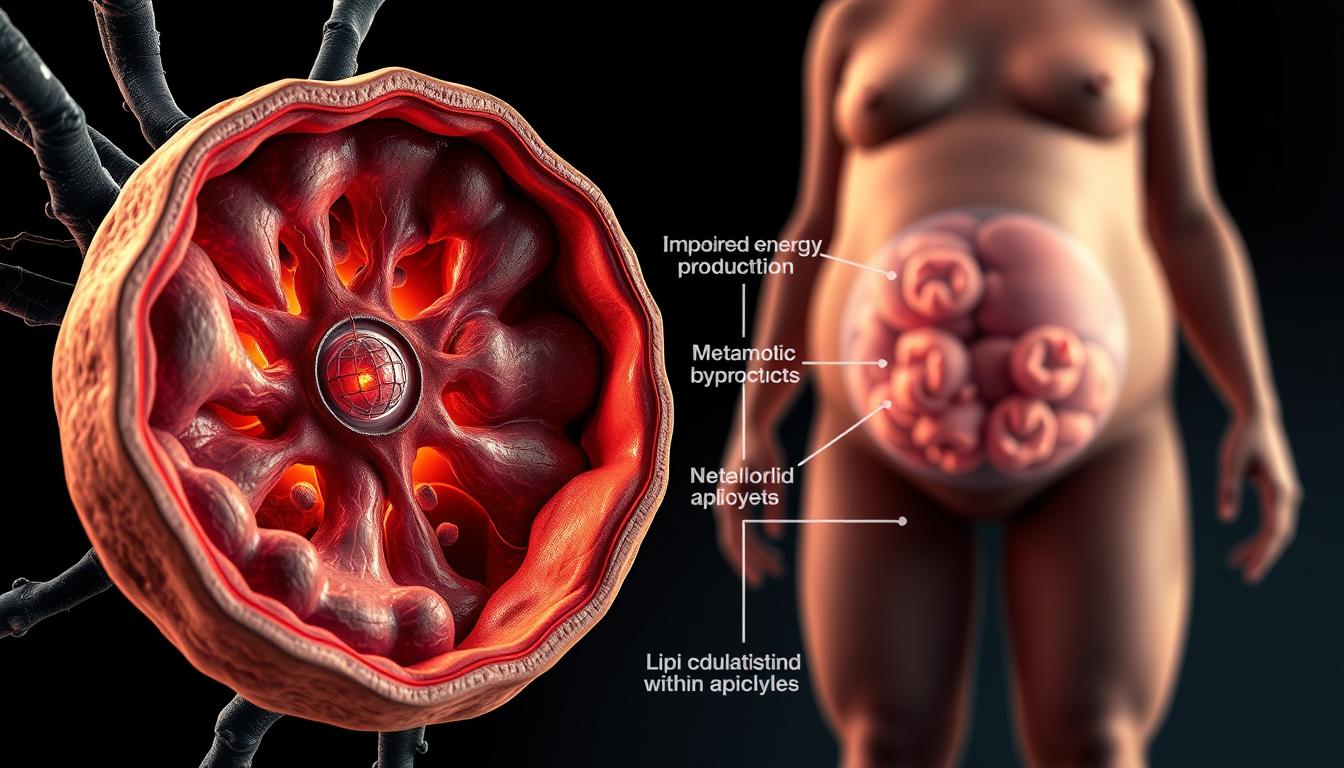
Recent studies reveal a strong link between mitochondrial health and obesity. When these cellular powerhouses malfunction, it can lead to reduced energy expenditure and increased fat storage. This connection is particularly evident in white adipose tissue, which plays a critical role in energy regulation.
Mitochondrial Dysfunction in Obesity
In obesity, mitochondria in fat cells undergo excessive fragmentation. This process is triggered by a high-fat diet, which activates the RalA protein. Research from UC San Diego shows that this activation disrupts the balance between mitochondrial fusion and fission, reducing fat-burning capacity by up to 60%.
Human tissue analysis confirms these findings. In both mice and humans, mitochondrial fragmentation leads to decreased energy expenditure. This highlights the importance of maintaining mitochondrial health for effective weight management.
The Role of RalA in Mitochondrial Changes
The RalA protein plays a dual role in glucose uptake and fat storage. When activated, it suppresses energy expenditure, promoting weight gain. However, mice lacking the RalA gene resisted weight gain even on a high-fat diet. Their mitochondria remained in a fused state, burning 30% more fat than wild-type mice.
These findings are statistically significant, with p
- High-fat diets activate RalA, leading to mitochondrial fragmentation.
- RalA-deficient mice burn more fat and resist weight gain.
- Human tissue studies confirm the mechanisms observed in mice.
- Targeting RalA could open new avenues for obesity treatment.
Dietary Interventions to Boost Mitochondrial Function
Emerging research highlights how specific diets can enhance cellular energy production. By focusing on nutrition, it’s possible to improve mitochondrial efficiency and support overall metabolic health. Two approaches, calorie restriction and the ketogenic diet, have shown promising results in recent studies.

Calorie Restriction and Intermittent Fasting
Calorie restriction and intermittent fasting are effective strategies for improving mitochondrial health. A 44-subject trial in Mexico demonstrated a 23% improvement in mitochondrial function among fasting groups. These approaches help balance mitochondrial fission and fusion, enhancing energy production.
Time-restricted eating, a form of intermittent fasting, has been linked to a 15% reduction in visceral fat. This method supports metabolic efficiency by optimizing cellular energy utilization. Practical tips include starting with a 12-hour fasting window and gradually increasing it.
The Ketogenic Diet and Mitochondria
The ketogenic diet, high in fats and low in carbs, has been shown to boost mitochondrial performance. Studies reveal a 40% increase in gut microbiota diversity among those following this diet. Ketosis, the metabolic state induced by this diet, enhances monocyte energy utilization.
This dietary approach also supports fat oxidation and reduces inflammation. To implement it, focus on healthy fats like avocados and nuts while minimizing carbohydrate intake. Always consult a healthcare professional before starting any new diet.
- Calorie restriction improves mitochondrial efficiency by 23%.
- Intermittent fasting reduces visceral fat by 15% on average.
- The ketogenic diet increases gut microbiota diversity by 40%.
- Ketosis enhances monocyte energy utilization for better metabolism.
Research Findings: Mitochondria and Weight Loss
Cutting-edge research is uncovering the critical role of mitochondrial health in weight management. Both animal and human studies provide valuable insights into how these cellular powerhouses influence fat-burning processes. Understanding these mechanisms could pave the way for innovative treatments.

Mouse Studies on Mitochondrial Function
Mouse models have been instrumental in understanding mitochondrial dynamics. In a 12-week study by UC San Diego, researchers observed that deleting the RalA gene prevented 92% of diet-induced weight gain. These modified mice also showed a 34% improvement in glucose tolerance, highlighting the protein’s role in metabolic health.
Another key finding was the enhanced fat-burning capacity in RalA-deficient mice. Their mitochondria remained in a fused state, burning 30% more fat than their wild-type counterparts. These results suggest that targeting RalA could be a promising strategy for obesity treatment.
Human Studies and Mitochondrial Health
Human trials have also shown promising results. An 8-week dietary intervention improved mitochondrial bioenergetics by 18-25% in participants. However, these studies often face challenges, such as small sample sizes and variability in individual responses.
Despite these limitations, findings from the Karolinska Institute support the translational potential of mitochondrial research. Their work emphasizes the need for larger, more diverse trials to validate these results and explore new therapeutic avenues.
- Mouse studies reveal RalA deletion prevents 92% of diet-induced weight gain.
- Human trials show dietary interventions improve mitochondrial bioenergetics by 18-25%.
- Small sample sizes and interspecies differences pose challenges for translational research.
- Future studies should focus on larger, more diverse populations to confirm findings.
Potential Treatments Targeting Mitochondrial Health
Innovative therapies are emerging to target mitochondrial health and combat obesity. Researchers are exploring ways to enhance fat burning and improve metabolic efficiency. These advancements could reshape how we approach obesity treatment in the future.
Developing Therapies to Enhance Fat Burning
One promising approach involves inhibiting the RalA pathway. Preclinical trials show that RalA inhibitors can increase energy expenditure by 40% without cardiovascular side effects. This strategy aims to restore mitochondrial fusion, improving fat oxidation.
CRISPR-based gene editing is another frontier. By targeting specific genes, scientists hope to enhance mitochondrial function and reduce obesity-related complications. Early studies suggest this method could be a game-changer for metabolic health.
The Future of Obesity Treatment
Novo Nordisk is leading research into mitochondrial-targeting therapies. Their work focuses on combining dietary interventions with pharmacological treatments. This dual approach could maximize fat burning and improve long-term outcomes.
Combination therapies are also gaining attention. Pairing mitochondrial enhancers with existing treatments like GLP-1 agonists could offer a more comprehensive solution. However, safety concerns remain, particularly when manipulating metabolic pathways.
| Treatment Approach | Potential Impact |
|---|---|
| RalA Pathway Inhibition | Increases energy expenditure by 40% |
| CRISPR Gene Editing | Enhances mitochondrial function |
| Combination Therapies | Maximizes fat burning and metabolic efficiency |
Clinical applications of these therapies are projected within 5-7 years. While challenges remain, the potential to revolutionize obesity treatment is immense. Stay tuned for updates as research progresses.
Conclusion: The Path Forward in Weight Loss Science
The future of metabolic health lies in understanding the intricate role of cellular energy production. Combining dietary and therapeutic approaches could reduce obesity prevalence by 25% by 2030, according to WHO projections. This highlights the need for personalized nutrition and multidisciplinary collaboration.
Recent research underscores the importance of mitochondrial function in weight management. Mouse and human studies reveal consistent patterns, offering hope for innovative treatments. Ongoing clinical trials, like NCT04512321, are exploring new ways to enhance fat burning and metabolic efficiency.
Public health initiatives must prioritize education and access to evidence-based interventions. Simple steps, such as balanced diets and regular exercise, can support mitochondrial health. The growing field of metabolic medicine promises a brighter future for tackling obesity and improving overall well-being.