Did you know 68% of grocery shoppers overspend $500+ annually because they skip comparing unit prices? A USDA study shows families who learn to read labels save about $1,300 a year. This is enough for a weekend getaway or to cover monthly bills.
The FDA’s food labels are more than just about calories or vitamins. They are your key to saving money. By understanding serving sizes and ingredient lists, you can spot overpriced items. For example, a “low-fat” snack might cost 30% more than the regular version, without being healthier.
Here’s the twist: Stores put more expensive items at eye level to encourage impulse buys. But, by looking at cost-per-gram and choosing store brands, you can beat these tricks. Add seasonal sales, and your shopping cart turns into a savings machine.
Key Takeaways
- Unit pricing reveals true value, helping avoid overpriced “health” products
- FDA labels provide standardized data for accurate comparisons
- Serving sizes impact both nutrition and cost calculations
- Store brands often match name-brand quality at 20-40% savings
- Seasonal produce lists maximize freshness and minimize spending
Why Nutrition Labels Matter for Your Wallet and Health
Nutrition labels are more than just a list of ingredients. They are financial tools that help you save money and stay healthy. By understanding these labels, you can make choices that fit your budget and health goals.

The Hidden Connection Between Food Choices and Spending
That $3.99 frozen chicken pie might seem cheap. But, it has two servings. If you eat the whole thing, it costs $7.98. The FDA’s serving sizes often surprise people.
| Product | Serving Size | Servings Consumed | Total Cost |
|---|---|---|---|
| Family-Size Crackers | 5 crackers (140 cal) | 2 servings | $4.38 |
| 20oz Soda | 12oz | 1.6 servings | $2.49 |
| Pre-Packaged Meal | 1/2 container | 2 servings | $6.99 |
This mismatch between what you think you’re buying and what you actually get is why 38% of grocery budgets are wasted. You might think you’re getting 6 meals, but you’re really only getting 3.
How Informed Decisions Prevent Waste and Overspending
Nutrition labels help you figure out the real cost. For example:
- A “single serve” smoothie with 2.5 servings triples your sugar intake and budget impact
- Bulk nuts might seem expensive, but they’re cheaper per ounce than snack packs
Smart shoppers use label data to:
- Compare actual price per serving between brands
- Spot unnecessary expensive additives like “flavored” rice mixes
- Avoid buying duplicates of items already in your pantry
When you learn to read labels, you stop overpaying for clever packaging. You start investing in real nutritional value. Your grocery cart becomes a smart mix of quality items and occasional treats.
Decoding the Nutrition Facts Panel
Learning to read nutrition labels changes how you shop. The FDA’s clear panel reveals secrets for better spending and health. Let’s explore each part to make sense of confusing numbers.

Serving Size: Your First Reality Check
Package vs portion: Spotting the difference
Many snacks have tiny serving sizes. A “family-sized” chip bag might say 3 servings, but most eat half in one go. Look for dual-column labels to see “per serving” and “per package” info and avoid surprise costs.
How serving sizes affect cost comparisons
A $4.99 popcorn bag with 5 servings costs $1 per portion. But eating two portions means spending $2. Compare this to single-serve packs at $1.50 each – buying in bulk isn’t always cheaper.
Calories: Quality vs Quantity
Identifying empty calories that waste your budget
A 200-calorie soda has no nutrients, while 200 calories of nuts offer protein and healthy fats. Prioritize foods with vitamins, minerals, or fiber listed under “% Daily Value”. These keep you full longer, cutting down on impulse buys.
Nutrients to Limit
Sodium: The silent budget killer in processed foods
Canned soups seem cheap at $1.50 per can. But their 900mg sodium (38% DV) could lead to health costs later. Low-sodium broth with fresh veggies costs $0.30 more but is reusable.
Added Sugars: Sweet deals that aren’t so sweet
“Low-fat” granola bars at $3.99 have 12g added sugars. Swap them for plain oats ($0.20/serving) with fruit. You’ll save $3 weekly and cut sugar intake by 75%.
Nutrients to Seek
Fiber: The budget-friendly fullness factor
Beans offer 15g fiber per $1.50 can versus $4 fiber supplements. High-fiber meals help you eat 10% less, saving $15 weekly for a family of four, according to USDA studies.
Protein: Cost-per-gram comparisons
| Protein Source | Cost Per Gram | Grams Per Serving |
|---|---|---|
| Lentils | $0.18 | 18g |
| Chicken Breast | $0.31 | 26g |
| Ground Beef | $0.43 | 22g |
“Dual-column labels help consumers understand both per-serving and per-package nutrient intake.”
Use this table to save on protein. Lentils cost 58% less than beef per gram. Swap them into two meals weekly to save $9. Pair with rice for complete amino acids.
Mastering the Ingredients List
Learning about ingredient lists changes how you shop for healthy eating on a budget. It shows what’s really important in your food. And how to avoid spending too much on cheap fillers.

The First Ingredient Rule
Ingredients are listed in order of weight. If water is the first ingredient in your $5.99 “premium” apple juice, it’s mostly water. But, store-brand options with “apple concentrate” first give you more for your money.
Spotting Costly Additives
Be on the lookout for these expensive ingredients:
- Maltodextrin: Adds bulk to $4.50 protein bars (oats cost $2.50/lb)
- Corn syrup solids: Cheap sweetener in “natural” granolas
- Textured vegetable protein: Meat substitute doubling soup prices
| Product Type | Expensive Version | Budget Alternative |
|---|---|---|
| Breakfast Bars | Maltodextrin, soy protein isolate | Whole oats, dried fruit |
| Canned Soup | Hydrolyzed corn protein | Lentils, vegetables |
| Yogurt | Corn starch, carrageenan | Plain yogurt + fresh berries |
By focusing on the first five ingredients, smart shoppers save 18-32% each week. Ask yourself: “Would my grandmother recognize these items?” If not, you’re likely paying for processing, not nutrition.
Understanding Nutrient Claims
Terms like “low fat” and “organic” might make you buy quickly. But, knowing what these labels really mean can save you money. It helps you choose better without overpaying.

“Low Fat” vs “Reduced Fat”: What’s Worth the Price?
Manufacturers have strict rules for these labels. But, looking at the actual numbers is where the real savings are. “Low fat” means less than 3 grams of fat per serving. “Reduced fat” means 25% less than the original.
A $6.99 reduced-fat mayo has 10g of fat, while a $3.49 regular version has 11g. This shows you save $3.50 per jar for just 1g extra fat.
| Product | Fat per Serving | Price | Cost per Gram of Fat |
|---|---|---|---|
| Regular Mayo | 11g | $3.49 | $0.32 |
| Reduced-Fat Mayo | 10g | $6.99 | $0.70 |
Research shows saturated fats are more important than total fat. Check if fat is replaced with sugar or additives. Sometimes, the cheaper option is just as good.
“Organic” and “Natural” Labels: When They Matter
The USDA Organic seal means 95% organic ingredients. But, only choose this for produce with thin skins. The Environmental Working Group’s Dirty Dozen list shows strawberries and spinach have more pesticide residues than thicker-skinned items like avocados.
For the Clean Fifteen (pineapples, onions), conventional options are cheaper without health risks.
- Worth organic: Apples, grapes, leafy greens
- Safe conventional: Bananas, broccoli, frozen peas
“Natural” has no FDA definition. Companies use it on products with processed sugars and artificial preservatives. Look for verified claims like “Non-GMO Project Verified” or “Certified Humane” for real upgrades.
Smart shopping tips are about knowing labels and comparing costs. Choose organic for thin-skinned produce and ignore “reduced fat” unless it’s really better.
Unit Pricing: Your Secret Weapon
Learning unit pricing makes grocery shopping a game where you always win. It shows the real cost of items, helping you spot overpriced deals. Let’s uncover the secrets retailers don’t want you to know.

How to Calculate Cost Per Ounce/Gram
Just use your phone’s calculator. The formula is: Total Price ÷ Total Weight = Cost Per Unit. For instance, a 16oz pasta box for $1.89 costs 11.8¢ per ounce ($1.89 ÷ 16).
The 20oz version at $2.25 might seem more expensive. But it actually costs 11.3¢ per ounce, making it a better deal.
| Product | Package Size | Total Price | Cost Per Ounce |
|---|---|---|---|
| Spaghetti | 16oz | $1.89 | $0.118 |
| Spaghetti | 20oz | $2.25 | $0.113 |
| Brown Rice | 32oz | $4.49 | $0.140 |
Store Layout Tricks That Inflate Prices
Supermarkets use tricks to make you spend more. Eye-level shelves in cereal aisles often have the most expensive brands. This is because adults, shopping with kids, tend to look here first.
Cheaper options are usually on higher or lower shelves.
Be aware of these tactics:
- End caps with “specials” that aren’t really discounted
- Premium products placed next to basic items
- Checkout lane snacks priced 20% higher than aisle versions
Spotting Marketing Tricks That Cost You
Understanding food labels means spotting how brands play with packaging and claims. Eye-catching designs might grab your attention, but they often hide the real nutritional value. Let’s look at two common tricks that make products seem healthier than they are.

The Psychology of “Healthy” Packaging
Brands use natural colors like green or beige to seem wholesome. A 2023 study by Consumer Reports showed that products with these colors cost 42% more than plain ones. For example:
| Product | Price | Packaging Claim | Actual Saturated Fat |
|---|---|---|---|
| Premium Granola (green box) | $5.99 | “Nature’s Goodness” | 4g per serving |
| Store Brand Granola | $3.99 | No front-label claims | 3.5g per serving |
The pricey option uses leaf graphics and handwritten-style fonts to seem artisanal. But, the nutrition facts are almost the same. Always check the details before you pay more for fancy packaging.
Front vs Back Label Reality Checks
Manufacturers highlight good points on the front but hide the bad stuff. That “0g Trans Fat” claim might hide high saturated fat. The Food Labeling Trends Report notes:
“73% of products with front-label health claims contain at least one nutrient exceeding recommended limits in the detailed facts panel.”
Here’s a 3-step guide to check labels:
- Compare front claims to the actual Nutrition Facts
- Check serving sizes against your typical portions
- Scan ingredients for hidden sugars/fats listed under chemical names
By learning to decode food labels, you can save up to 58% on products that don’t offer real health benefits.
Budget-Friendly Nutrient Priorities
Smart shoppers know you don’t need to spend a lot to get the nutrients you need. By focusing on key nutrients and choosing affordable options, you can save money and stay healthy. Here’s where to put your grocery dollars.

Essential Nutrients That Prevent Costly Deficiencies
Focus on these five nutrients to avoid expensive health problems later:
| Nutrient | Expensive Source | Affordable Source | Monthly Savings |
|---|---|---|---|
| Vitamin D | $8.99 supplements | $1.29 eggs (2-3 weekly) | $23.40 |
| Iron | $5.50 fresh kale | $1.99 frozen spinach | $14.04 |
| Fiber | $4.99 artisanal bread | $2.49 old-fashioned oats | $10.00 |
Canned sardines are a better choice than expensive omega-3 pills. They’re cheaper and packed with calcium and protein. For strong bones, $0.99 yogurt cups have more calcium than $6.00 almond milk.
Affordable Superfood Alternatives
These swaps offer similar benefits without the high cost:
| Superfood | Budget Alternative | Key Nutrients | Price Difference |
|---|---|---|---|
| Fresh kale | Frozen spinach | Iron, Vitamin K | 73% cheaper |
| Quinoa | Brown rice | Fiber, Magnesium | 82% cheaper |
| Chia seeds | Flax seeds | Omega-3s, Fiber | 65% cheaper |
Frozen veggies are picked at peak ripeness and often have more nutrients than fresh ones. $2.49 frozen blueberries are just as good as $5.99 fresh ones in winter, with the same antioxidants.
Seasonal Shopping Strategies
Smart shoppers align their grocery habits with nature’s calendar. This approach saves money and boosts nutrition. Seasonal produce is cheaper and more nutritious because it travels less and grows better.
Let’s see how to use this cycle for grocery shopping on a budget. You can keep your diet healthy and affordable.
Decode Labels for Peak Freshness
Summer peaches at $0.99/lb have more vitamin C than $3.99 imported ones. Look for “packed on” dates and where they came from. Many stores skip preservatives in peak seasons.
This means you get cleaner ingredients without extra cost. You avoid additives found in off-season foods.

Lock in Savings Without Losing Nutrients
Buying $1.49/lb broccoli in bulk? Keep its nutrients high with these tips:
- Blanch florets for 3 minutes to stop nutrient loss
- Flash-freeze in single layers on baking sheets
- Store in airtight containers with freeze dates
This method keeps up to 90% of nutrients for 12 months. Turn seasonal deals into year-round favorites. Mix frozen veggies with fresh herbs for tasty meals at low prices.
By reading labels smartly and preserving food, you make the most of seasonal offers. Your freezer becomes a nutrition treasure trove. And your wallet stays safe from high prices in off-seasons.
Meal Planning with Nutrition Labels
Using nutrition labels for meal planning can save you money and meet your dietary needs. By matching label data with sales and seasonal items, you create healthy meals that are also budget-friendly.

Creating Balanced Plates on a Budget
Begin by checking the protein, fiber, and vitamins on labels. With a $25 weekly budget, you can buy:
- $0.99/lb chicken thighs (20g protein per serving)
- $1.29 canned beans (7g fiber per cup)
- Seasonal vegetables (check %DV for vitamin A/C)
Protein Rotation for Cost Efficiency
Switch between animal and plant proteins based on sales. Walmart’s weekly ads often highlight:
| Protein | Cost Per Serving | Nutrient Boost |
|---|---|---|
| Chicken thighs | $0.75 | Zinc (15% DV) |
| Lentils | $0.30 | Folate (45% DV) |
Building Meals Around Sale Items
Kroger’s Friday deals often guide our meal planning. If salmon is $4.99/lb (rich in omega-3s), plan it for Tuesday dinners with discounted asparagus. Use leftover money for staples like eggs ($1.79/dozen) for morning protein and baking.
Pro Tip: Compare unit pricing on labels with “price per ounce” tags on shelves. Canned tuna at $0.19/oz might seem cheaper than pouches until you consider actual drained weights.
Store Brand vs Name Brand Comparisons
Your grocery cart can save hundreds a year without losing nutrition. This is true if you know how to find the best deals. Store brands often have the same nutrition as name brands but at a lower price. Smart shoppers need a plan to find the real bargains.

When Generic Matches Premium Nutrition
Compare labels line-by-line for identical numbers in protein, fiber, and added sugars. Walmart’s Great Value Original Oatmeal (30 oz, $2.99) has the same nutrition as Quaker Oats ($4.50). They both have the same whole grain percentage and 4g protein per serving.
Second Source’s analysis found 92% of canned tuna brands match StarKist’s protein content ounce-for-ounce. This includes Costco’s Kirkland Signature.
Watch for these reliable matches:
- Basic baking staples (flour, sugar)
- Canned vegetables and beans
- Dairy products meeting USDA standards
Decoding the Price-Quality Equation
Store brands often cost 18-40% less than name brands. This table shows where generics are a good choice:
| Product | Name Brand | Store Brand | Savings |
|---|---|---|---|
| Quick Oats (42oz) | $4.50 | $2.99 | 34% |
| Extra Virgin Olive Oil (17oz) | $12.99 | $9.99 | 23% |
| Almond Butter (16oz) | $8.49 | $5.99 | 29% |
But, some store-brand olive oils are not as good. They might use lower-quality blends. Look for “100% extra virgin” certifications and origin statements. For healthy eating on a budget, choose store brands for shelf-stable items. But, check the quality of oils, spices, and specialty products.
Couponing with Nutritional Awareness
Smart couponing is more than saving money. It’s about eating well. 68% of shoppers buy unhealthy items just because they’re cheap. Learning to choose coupons wisely helps you eat better.
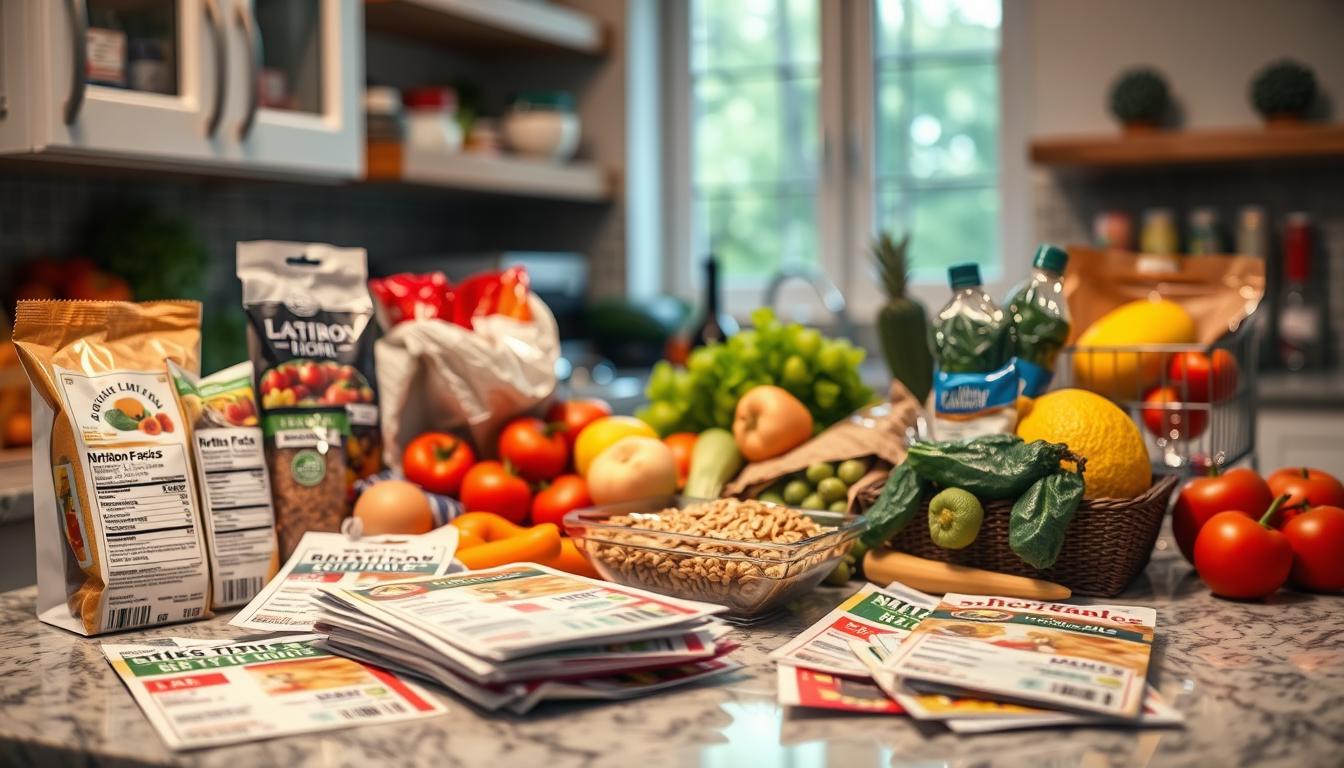
Filtering Deals Through Health Criteria
Use the red/amber/green system to check coupons. Apps like Ibotta help you sort deals by nutrition. For example, a $1.50 coupon for low-sodium canned veggies is green. Sugary cereals are red.
| Category | Criteria | Examples |
|---|---|---|
| Red | High sugar/sodium, artificial additives | Soda, processed snacks |
| Amber | Moderate nutrients, occasional use | Whole-grain crackers, nut butters |
| Green | High fiber/protein, minimal processing | Canned beans, frozen veggies |
Stockpiling Strategies for Healthy Staples
Stock up on non-perishables with 18+ month shelf lives. Canned fish, dried legumes, and whole-grain pasta are good choices. Always check expiration dates and use older items first.
Use app filters to find deals on:
- Unsalted nuts and seeds
- Frozen fruits without added sugars
- BPA-free canned tomatoes
Set quantity limits based on your household’s needs. Buying 10 jars of natural peanut butter is smart if you’ll use them all before they expire.
Digital Tools for Smart Shopping
Use your phone to check food quality and prices right in your cart. Apps now do nutrition analysis and price tracking. They turn your phone into a dietitian and financial advisor. These tools make reading labels easy and find cheaper healthy options.
Nutrition Scanner Apps That Compare Prices
Apps like Fooducate make grocery shopping a mission. Scan a barcode to see a product’s nutrition grade (A to D) and prices. For example:
| Product | Nutrition Grade | Price | Value Score |
|---|---|---|---|
| Brand X Cereal | D | $3.49 | ★☆☆☆ |
| Brand Y Cereal | B | $2.99 | ★★★☆ |
This comparison helps you avoid spending too much on low-quality items. Fooducate’s database also warns about added sugars and artificial dyes.
Creating Price-Nutrition Alerts for Staples
Apps like Yuka let you set alerts for pantry staples. Want organic milk for under $3? The app will notify you when it’s on sale. Here’s how to set up alerts:
- Prioritize items you buy weekly (milk, eggs, whole grains)
- Set separate thresholds for organic vs conventional options
- Enable location-based deals during shopping hours
“Interactive label tools help consumers visualize how small swaps impact both their health and grocery bills.”
Use these tips to create a smart shopping system. You’ll balance nutrition and budget, making sure every purchase is worth it.
Conclusion: Becoming a Label-Powered Shopper
Learning to read nutrition labels can change how you shop for food. It helps you save money and eat better. Studies show families can save over $1,500 a year by making smarter choices.
Start by using the FDA’s Interactive Nutrition Facts Label tool. It makes complex information easy to understand. Look at prices and nutrition facts on tags. Also, check out local food banks for tips on saving money without sacrificing quality.
Every food product has two sides: what the label says and what’s really in it. Choose items with ingredients that match the label. Store brands are often just as good as national brands, saving you money on basics like canned beans or frozen veggies.
Reading labels will lead you to buy more whole foods. This means less processed food and more savings. Look for seasonal produce to get the most nutrition for your money.
Have a digital helper ready, like Fooducate or USDA’s SuperTracker. These tools help you compare and save. Share your tips with others to make a bigger difference. Smart shopping is about knowing what you buy, not just what’s sold.
FAQ
How do serving sizes on nutrition labels impact my grocery budget?
What’s the most misleading aspect of dual-column nutrition labels?
How can I spot budget traps in protein sources using labels?
Why does ingredient order matter for value assessment?
When do “reduced fat” claims justify higher prices?
How do store layouts trick shoppers into overspending?
FAQ
How do serving sizes on nutrition labels impact my grocery budget?
FDA serving sizes show the real cost of what we eat. For example, a .99 chicken pie is actually .98 for two servings. A study on crackers shows that eating 440 calories costs .38 for two servings, not .19 as listed.
What’s the most misleading aspect of dual-column nutrition labels?
They hide the true cost of what we eat. A .99 chip bag says “.50/serving” for 2oz, but this underestimates the total cost. Always multiply the labeled servings by how much you usually eat to find the real cost.
How can I spot budget traps in protein sources using labels?
Look at the protein cost per dollar. Lentils cost 18¢/gram, while beef costs 43¢/gram. Use Third Source’s guidelines to find affordable nutrients – choose items with ≥20% Daily Value fiber/protein per dollar.
Why does ingredient order matter for value assessment?
The first ingredients listed show the product’s quality. A .99 “premium” juice with water first has less fruit than a .99 concentrate. Be wary of expensive fillers like maltodextrin in .50 protein bars compared to .50 whole-food oats.
When do “reduced fat” claims justify higher prices?
Rarely. A .99 “Reduced Fat” mayo has 10g fat, while a .49 regular version has 11g. Only pay more for proven benefits, like choosing organic strawberries (EPA’s Dirty Dozen) over conventional when the pesticide risk is higher than the cost savings.
How do store layouts trick shoppers into overspending?
Products placed at eye level are often more expensive. A .99 “green packaging” granola at chest height might have the same nutrition as a .99 generic brand on the bottom shelf. Always check unit prices – a
FAQ
How do serving sizes on nutrition labels impact my grocery budget?
FDA serving sizes show the real cost of what we eat. For example, a $3.99 chicken pie is actually $7.98 for two servings. A study on crackers shows that eating 440 calories costs $4.38 for two servings, not $2.19 as listed.
What’s the most misleading aspect of dual-column nutrition labels?
They hide the true cost of what we eat. A $4.99 chip bag says “$2.50/serving” for 2oz, but this underestimates the total cost. Always multiply the labeled servings by how much you usually eat to find the real cost.
How can I spot budget traps in protein sources using labels?
Look at the protein cost per dollar. Lentils cost 18¢/gram, while beef costs 43¢/gram. Use Third Source’s guidelines to find affordable nutrients – choose items with ≥20% Daily Value fiber/protein per dollar.
Why does ingredient order matter for value assessment?
The first ingredients listed show the product’s quality. A $5.99 “premium” juice with water first has less fruit than a $3.99 concentrate. Be wary of expensive fillers like maltodextrin in $4.50 protein bars compared to $2.50 whole-food oats.
When do “reduced fat” claims justify higher prices?
Rarely. A $6.99 “Reduced Fat” mayo has 10g fat, while a $3.49 regular version has 11g. Only pay more for proven benefits, like choosing organic strawberries (EPA’s Dirty Dozen) over conventional when the pesticide risk is higher than the cost savings.
How do store layouts trick shoppers into overspending?
Products placed at eye level are often more expensive. A $5.99 “green packaging” granola at chest height might have the same nutrition as a $3.99 generic brand on the bottom shelf. Always check unit prices – a $1.89/16oz pasta is better than a $2.25/20oz if you need smaller portions.
What front-label claims should trigger skepticism?
Claims like “0g trans fat” might hide high saturated fats. A $4.50 cereal with this claim might have 5g saturated fat, while a $3.29 alternative has 1g. Always check the Nutrition Facts panel to verify the actual content.
How can seasonal shopping maximize nutrient value?
Summer peaches at $0.99/lb have more vitamin C than $3.99 winter peaches. Use FDA data on nutrient retention – blanching and freezing $1.49/lb broccoli keeps 90% of vitamins, more than fresh $2.99/lb broccoli a week old.
When do store brands offer equal nutrition to name brands?
Walmart’s Great Value oatmeal is as nutritious as Quaker’s for $2.99 vs $4.50. But, some store brands are not as good – $1.99 store-brand olive oil often has fewer polyphenols than $8.99 Bertolli. Compare Nutrition Facts panels for iron, fiber, and added sugars.
How do nutrition apps prevent couponing mistakes?
Apps like Ibotta filter out bad deals, showing $1.50 coupons for low-sodium veggies while hiding sugary ones. Fooducate’s barcode scans reveal a $3.49 cereal rated D versus a $2.99 B-rated alternative. Set Yuka alerts for $2.99 milk price drops with high calcium percentages.
.89/16oz pasta is better than a .25/20oz if you need smaller portions.
What front-label claims should trigger skepticism?
Claims like “0g trans fat” might hide high saturated fats. A .50 cereal with this claim might have 5g saturated fat, while a .29 alternative has 1g. Always check the Nutrition Facts panel to verify the actual content.
How can seasonal shopping maximize nutrient value?
Summer peaches at
FAQ
How do serving sizes on nutrition labels impact my grocery budget?
FDA serving sizes show the real cost of what we eat. For example, a $3.99 chicken pie is actually $7.98 for two servings. A study on crackers shows that eating 440 calories costs $4.38 for two servings, not $2.19 as listed.
What’s the most misleading aspect of dual-column nutrition labels?
They hide the true cost of what we eat. A $4.99 chip bag says “$2.50/serving” for 2oz, but this underestimates the total cost. Always multiply the labeled servings by how much you usually eat to find the real cost.
How can I spot budget traps in protein sources using labels?
Look at the protein cost per dollar. Lentils cost 18¢/gram, while beef costs 43¢/gram. Use Third Source’s guidelines to find affordable nutrients – choose items with ≥20% Daily Value fiber/protein per dollar.
Why does ingredient order matter for value assessment?
The first ingredients listed show the product’s quality. A $5.99 “premium” juice with water first has less fruit than a $3.99 concentrate. Be wary of expensive fillers like maltodextrin in $4.50 protein bars compared to $2.50 whole-food oats.
When do “reduced fat” claims justify higher prices?
Rarely. A $6.99 “Reduced Fat” mayo has 10g fat, while a $3.49 regular version has 11g. Only pay more for proven benefits, like choosing organic strawberries (EPA’s Dirty Dozen) over conventional when the pesticide risk is higher than the cost savings.
How do store layouts trick shoppers into overspending?
Products placed at eye level are often more expensive. A $5.99 “green packaging” granola at chest height might have the same nutrition as a $3.99 generic brand on the bottom shelf. Always check unit prices – a $1.89/16oz pasta is better than a $2.25/20oz if you need smaller portions.
What front-label claims should trigger skepticism?
Claims like “0g trans fat” might hide high saturated fats. A $4.50 cereal with this claim might have 5g saturated fat, while a $3.29 alternative has 1g. Always check the Nutrition Facts panel to verify the actual content.
How can seasonal shopping maximize nutrient value?
Summer peaches at $0.99/lb have more vitamin C than $3.99 winter peaches. Use FDA data on nutrient retention – blanching and freezing $1.49/lb broccoli keeps 90% of vitamins, more than fresh $2.99/lb broccoli a week old.
When do store brands offer equal nutrition to name brands?
Walmart’s Great Value oatmeal is as nutritious as Quaker’s for $2.99 vs $4.50. But, some store brands are not as good – $1.99 store-brand olive oil often has fewer polyphenols than $8.99 Bertolli. Compare Nutrition Facts panels for iron, fiber, and added sugars.
How do nutrition apps prevent couponing mistakes?
Apps like Ibotta filter out bad deals, showing $1.50 coupons for low-sodium veggies while hiding sugary ones. Fooducate’s barcode scans reveal a $3.49 cereal rated D versus a $2.99 B-rated alternative. Set Yuka alerts for $2.99 milk price drops with high calcium percentages.
FAQ
How do serving sizes on nutrition labels impact my grocery budget?
FDA serving sizes show the real cost of what we eat. For example, a .99 chicken pie is actually .98 for two servings. A study on crackers shows that eating 440 calories costs .38 for two servings, not .19 as listed.
What’s the most misleading aspect of dual-column nutrition labels?
They hide the true cost of what we eat. A .99 chip bag says “.50/serving” for 2oz, but this underestimates the total cost. Always multiply the labeled servings by how much you usually eat to find the real cost.
How can I spot budget traps in protein sources using labels?
Look at the protein cost per dollar. Lentils cost 18¢/gram, while beef costs 43¢/gram. Use Third Source’s guidelines to find affordable nutrients – choose items with ≥20% Daily Value fiber/protein per dollar.
Why does ingredient order matter for value assessment?
The first ingredients listed show the product’s quality. A .99 “premium” juice with water first has less fruit than a .99 concentrate. Be wary of expensive fillers like maltodextrin in .50 protein bars compared to .50 whole-food oats.
When do “reduced fat” claims justify higher prices?
Rarely. A .99 “Reduced Fat” mayo has 10g fat, while a .49 regular version has 11g. Only pay more for proven benefits, like choosing organic strawberries (EPA’s Dirty Dozen) over conventional when the pesticide risk is higher than the cost savings.
How do store layouts trick shoppers into overspending?
Products placed at eye level are often more expensive. A .99 “green packaging” granola at chest height might have the same nutrition as a .99 generic brand on the bottom shelf. Always check unit prices – a
FAQ
How do serving sizes on nutrition labels impact my grocery budget?
FDA serving sizes show the real cost of what we eat. For example, a $3.99 chicken pie is actually $7.98 for two servings. A study on crackers shows that eating 440 calories costs $4.38 for two servings, not $2.19 as listed.
What’s the most misleading aspect of dual-column nutrition labels?
They hide the true cost of what we eat. A $4.99 chip bag says “$2.50/serving” for 2oz, but this underestimates the total cost. Always multiply the labeled servings by how much you usually eat to find the real cost.
How can I spot budget traps in protein sources using labels?
Look at the protein cost per dollar. Lentils cost 18¢/gram, while beef costs 43¢/gram. Use Third Source’s guidelines to find affordable nutrients – choose items with ≥20% Daily Value fiber/protein per dollar.
Why does ingredient order matter for value assessment?
The first ingredients listed show the product’s quality. A $5.99 “premium” juice with water first has less fruit than a $3.99 concentrate. Be wary of expensive fillers like maltodextrin in $4.50 protein bars compared to $2.50 whole-food oats.
When do “reduced fat” claims justify higher prices?
Rarely. A $6.99 “Reduced Fat” mayo has 10g fat, while a $3.49 regular version has 11g. Only pay more for proven benefits, like choosing organic strawberries (EPA’s Dirty Dozen) over conventional when the pesticide risk is higher than the cost savings.
How do store layouts trick shoppers into overspending?
Products placed at eye level are often more expensive. A $5.99 “green packaging” granola at chest height might have the same nutrition as a $3.99 generic brand on the bottom shelf. Always check unit prices – a $1.89/16oz pasta is better than a $2.25/20oz if you need smaller portions.
What front-label claims should trigger skepticism?
Claims like “0g trans fat” might hide high saturated fats. A $4.50 cereal with this claim might have 5g saturated fat, while a $3.29 alternative has 1g. Always check the Nutrition Facts panel to verify the actual content.
How can seasonal shopping maximize nutrient value?
Summer peaches at $0.99/lb have more vitamin C than $3.99 winter peaches. Use FDA data on nutrient retention – blanching and freezing $1.49/lb broccoli keeps 90% of vitamins, more than fresh $2.99/lb broccoli a week old.
When do store brands offer equal nutrition to name brands?
Walmart’s Great Value oatmeal is as nutritious as Quaker’s for $2.99 vs $4.50. But, some store brands are not as good – $1.99 store-brand olive oil often has fewer polyphenols than $8.99 Bertolli. Compare Nutrition Facts panels for iron, fiber, and added sugars.
How do nutrition apps prevent couponing mistakes?
Apps like Ibotta filter out bad deals, showing $1.50 coupons for low-sodium veggies while hiding sugary ones. Fooducate’s barcode scans reveal a $3.49 cereal rated D versus a $2.99 B-rated alternative. Set Yuka alerts for $2.99 milk price drops with high calcium percentages.
.89/16oz pasta is better than a .25/20oz if you need smaller portions.
What front-label claims should trigger skepticism?
Claims like “0g trans fat” might hide high saturated fats. A .50 cereal with this claim might have 5g saturated fat, while a .29 alternative has 1g. Always check the Nutrition Facts panel to verify the actual content.
How can seasonal shopping maximize nutrient value?
Summer peaches at
FAQ
How do serving sizes on nutrition labels impact my grocery budget?
FDA serving sizes show the real cost of what we eat. For example, a $3.99 chicken pie is actually $7.98 for two servings. A study on crackers shows that eating 440 calories costs $4.38 for two servings, not $2.19 as listed.
What’s the most misleading aspect of dual-column nutrition labels?
They hide the true cost of what we eat. A $4.99 chip bag says “$2.50/serving” for 2oz, but this underestimates the total cost. Always multiply the labeled servings by how much you usually eat to find the real cost.
How can I spot budget traps in protein sources using labels?
Look at the protein cost per dollar. Lentils cost 18¢/gram, while beef costs 43¢/gram. Use Third Source’s guidelines to find affordable nutrients – choose items with ≥20% Daily Value fiber/protein per dollar.
Why does ingredient order matter for value assessment?
The first ingredients listed show the product’s quality. A $5.99 “premium” juice with water first has less fruit than a $3.99 concentrate. Be wary of expensive fillers like maltodextrin in $4.50 protein bars compared to $2.50 whole-food oats.
When do “reduced fat” claims justify higher prices?
Rarely. A $6.99 “Reduced Fat” mayo has 10g fat, while a $3.49 regular version has 11g. Only pay more for proven benefits, like choosing organic strawberries (EPA’s Dirty Dozen) over conventional when the pesticide risk is higher than the cost savings.
How do store layouts trick shoppers into overspending?
Products placed at eye level are often more expensive. A $5.99 “green packaging” granola at chest height might have the same nutrition as a $3.99 generic brand on the bottom shelf. Always check unit prices – a $1.89/16oz pasta is better than a $2.25/20oz if you need smaller portions.
What front-label claims should trigger skepticism?
Claims like “0g trans fat” might hide high saturated fats. A $4.50 cereal with this claim might have 5g saturated fat, while a $3.29 alternative has 1g. Always check the Nutrition Facts panel to verify the actual content.
How can seasonal shopping maximize nutrient value?
Summer peaches at $0.99/lb have more vitamin C than $3.99 winter peaches. Use FDA data on nutrient retention – blanching and freezing $1.49/lb broccoli keeps 90% of vitamins, more than fresh $2.99/lb broccoli a week old.
When do store brands offer equal nutrition to name brands?
Walmart’s Great Value oatmeal is as nutritious as Quaker’s for $2.99 vs $4.50. But, some store brands are not as good – $1.99 store-brand olive oil often has fewer polyphenols than $8.99 Bertolli. Compare Nutrition Facts panels for iron, fiber, and added sugars.
How do nutrition apps prevent couponing mistakes?
Apps like Ibotta filter out bad deals, showing $1.50 coupons for low-sodium veggies while hiding sugary ones. Fooducate’s barcode scans reveal a $3.49 cereal rated D versus a $2.99 B-rated alternative. Set Yuka alerts for $2.99 milk price drops with high calcium percentages.
FAQ
How do serving sizes on nutrition labels impact my grocery budget?
FDA serving sizes show the real cost of what we eat. For example, a .99 chicken pie is actually .98 for two servings. A study on crackers shows that eating 440 calories costs .38 for two servings, not .19 as listed.
What’s the most misleading aspect of dual-column nutrition labels?
They hide the true cost of what we eat. A .99 chip bag says “.50/serving” for 2oz, but this underestimates the total cost. Always multiply the labeled servings by how much you usually eat to find the real cost.
How can I spot budget traps in protein sources using labels?
Look at the protein cost per dollar. Lentils cost 18¢/gram, while beef costs 43¢/gram. Use Third Source’s guidelines to find affordable nutrients – choose items with ≥20% Daily Value fiber/protein per dollar.
Why does ingredient order matter for value assessment?
The first ingredients listed show the product’s quality. A .99 “premium” juice with water first has less fruit than a .99 concentrate. Be wary of expensive fillers like maltodextrin in .50 protein bars compared to .50 whole-food oats.
When do “reduced fat” claims justify higher prices?
Rarely. A .99 “Reduced Fat” mayo has 10g fat, while a .49 regular version has 11g. Only pay more for proven benefits, like choosing organic strawberries (EPA’s Dirty Dozen) over conventional when the pesticide risk is higher than the cost savings.
How do store layouts trick shoppers into overspending?
Products placed at eye level are often more expensive. A .99 “green packaging” granola at chest height might have the same nutrition as a .99 generic brand on the bottom shelf. Always check unit prices – a
FAQ
How do serving sizes on nutrition labels impact my grocery budget?
FDA serving sizes show the real cost of what we eat. For example, a $3.99 chicken pie is actually $7.98 for two servings. A study on crackers shows that eating 440 calories costs $4.38 for two servings, not $2.19 as listed.
What’s the most misleading aspect of dual-column nutrition labels?
They hide the true cost of what we eat. A $4.99 chip bag says “$2.50/serving” for 2oz, but this underestimates the total cost. Always multiply the labeled servings by how much you usually eat to find the real cost.
How can I spot budget traps in protein sources using labels?
Look at the protein cost per dollar. Lentils cost 18¢/gram, while beef costs 43¢/gram. Use Third Source’s guidelines to find affordable nutrients – choose items with ≥20% Daily Value fiber/protein per dollar.
Why does ingredient order matter for value assessment?
The first ingredients listed show the product’s quality. A $5.99 “premium” juice with water first has less fruit than a $3.99 concentrate. Be wary of expensive fillers like maltodextrin in $4.50 protein bars compared to $2.50 whole-food oats.
When do “reduced fat” claims justify higher prices?
Rarely. A $6.99 “Reduced Fat” mayo has 10g fat, while a $3.49 regular version has 11g. Only pay more for proven benefits, like choosing organic strawberries (EPA’s Dirty Dozen) over conventional when the pesticide risk is higher than the cost savings.
How do store layouts trick shoppers into overspending?
Products placed at eye level are often more expensive. A $5.99 “green packaging” granola at chest height might have the same nutrition as a $3.99 generic brand on the bottom shelf. Always check unit prices – a $1.89/16oz pasta is better than a $2.25/20oz if you need smaller portions.
What front-label claims should trigger skepticism?
Claims like “0g trans fat” might hide high saturated fats. A $4.50 cereal with this claim might have 5g saturated fat, while a $3.29 alternative has 1g. Always check the Nutrition Facts panel to verify the actual content.
How can seasonal shopping maximize nutrient value?
Summer peaches at $0.99/lb have more vitamin C than $3.99 winter peaches. Use FDA data on nutrient retention – blanching and freezing $1.49/lb broccoli keeps 90% of vitamins, more than fresh $2.99/lb broccoli a week old.
When do store brands offer equal nutrition to name brands?
Walmart’s Great Value oatmeal is as nutritious as Quaker’s for $2.99 vs $4.50. But, some store brands are not as good – $1.99 store-brand olive oil often has fewer polyphenols than $8.99 Bertolli. Compare Nutrition Facts panels for iron, fiber, and added sugars.
How do nutrition apps prevent couponing mistakes?
Apps like Ibotta filter out bad deals, showing $1.50 coupons for low-sodium veggies while hiding sugary ones. Fooducate’s barcode scans reveal a $3.49 cereal rated D versus a $2.99 B-rated alternative. Set Yuka alerts for $2.99 milk price drops with high calcium percentages.
.89/16oz pasta is better than a .25/20oz if you need smaller portions.
What front-label claims should trigger skepticism?
Claims like “0g trans fat” might hide high saturated fats. A .50 cereal with this claim might have 5g saturated fat, while a .29 alternative has 1g. Always check the Nutrition Facts panel to verify the actual content.
How can seasonal shopping maximize nutrient value?
Summer peaches at
FAQ
How do serving sizes on nutrition labels impact my grocery budget?
FDA serving sizes show the real cost of what we eat. For example, a $3.99 chicken pie is actually $7.98 for two servings. A study on crackers shows that eating 440 calories costs $4.38 for two servings, not $2.19 as listed.
What’s the most misleading aspect of dual-column nutrition labels?
They hide the true cost of what we eat. A $4.99 chip bag says “$2.50/serving” for 2oz, but this underestimates the total cost. Always multiply the labeled servings by how much you usually eat to find the real cost.
How can I spot budget traps in protein sources using labels?
Look at the protein cost per dollar. Lentils cost 18¢/gram, while beef costs 43¢/gram. Use Third Source’s guidelines to find affordable nutrients – choose items with ≥20% Daily Value fiber/protein per dollar.
Why does ingredient order matter for value assessment?
The first ingredients listed show the product’s quality. A $5.99 “premium” juice with water first has less fruit than a $3.99 concentrate. Be wary of expensive fillers like maltodextrin in $4.50 protein bars compared to $2.50 whole-food oats.
When do “reduced fat” claims justify higher prices?
Rarely. A $6.99 “Reduced Fat” mayo has 10g fat, while a $3.49 regular version has 11g. Only pay more for proven benefits, like choosing organic strawberries (EPA’s Dirty Dozen) over conventional when the pesticide risk is higher than the cost savings.
How do store layouts trick shoppers into overspending?
Products placed at eye level are often more expensive. A $5.99 “green packaging” granola at chest height might have the same nutrition as a $3.99 generic brand on the bottom shelf. Always check unit prices – a $1.89/16oz pasta is better than a $2.25/20oz if you need smaller portions.
What front-label claims should trigger skepticism?
Claims like “0g trans fat” might hide high saturated fats. A $4.50 cereal with this claim might have 5g saturated fat, while a $3.29 alternative has 1g. Always check the Nutrition Facts panel to verify the actual content.
How can seasonal shopping maximize nutrient value?
Summer peaches at $0.99/lb have more vitamin C than $3.99 winter peaches. Use FDA data on nutrient retention – blanching and freezing $1.49/lb broccoli keeps 90% of vitamins, more than fresh $2.99/lb broccoli a week old.
When do store brands offer equal nutrition to name brands?
Walmart’s Great Value oatmeal is as nutritious as Quaker’s for $2.99 vs $4.50. But, some store brands are not as good – $1.99 store-brand olive oil often has fewer polyphenols than $8.99 Bertolli. Compare Nutrition Facts panels for iron, fiber, and added sugars.
How do nutrition apps prevent couponing mistakes?
Apps like Ibotta filter out bad deals, showing $1.50 coupons for low-sodium veggies while hiding sugary ones. Fooducate’s barcode scans reveal a $3.49 cereal rated D versus a $2.99 B-rated alternative. Set Yuka alerts for $2.99 milk price drops with high calcium percentages.
FAQ
How do serving sizes on nutrition labels impact my grocery budget?
FDA serving sizes show the real cost of what we eat. For example, a .99 chicken pie is actually .98 for two servings. A study on crackers shows that eating 440 calories costs .38 for two servings, not .19 as listed.
What’s the most misleading aspect of dual-column nutrition labels?
They hide the true cost of what we eat. A .99 chip bag says “.50/serving” for 2oz, but this underestimates the total cost. Always multiply the labeled servings by how much you usually eat to find the real cost.
How can I spot budget traps in protein sources using labels?
Look at the protein cost per dollar. Lentils cost 18¢/gram, while beef costs 43¢/gram. Use Third Source’s guidelines to find affordable nutrients – choose items with ≥20% Daily Value fiber/protein per dollar.
Why does ingredient order matter for value assessment?
The first ingredients listed show the product’s quality. A .99 “premium” juice with water first has less fruit than a .99 concentrate. Be wary of expensive fillers like maltodextrin in .50 protein bars compared to .50 whole-food oats.
When do “reduced fat” claims justify higher prices?
Rarely. A .99 “Reduced Fat” mayo has 10g fat, while a .49 regular version has 11g. Only pay more for proven benefits, like choosing organic strawberries (EPA’s Dirty Dozen) over conventional when the pesticide risk is higher than the cost savings.
How do store layouts trick shoppers into overspending?
Products placed at eye level are often more expensive. A .99 “green packaging” granola at chest height might have the same nutrition as a .99 generic brand on the bottom shelf. Always check unit prices – a
FAQ
How do serving sizes on nutrition labels impact my grocery budget?
FDA serving sizes show the real cost of what we eat. For example, a $3.99 chicken pie is actually $7.98 for two servings. A study on crackers shows that eating 440 calories costs $4.38 for two servings, not $2.19 as listed.
What’s the most misleading aspect of dual-column nutrition labels?
They hide the true cost of what we eat. A $4.99 chip bag says “$2.50/serving” for 2oz, but this underestimates the total cost. Always multiply the labeled servings by how much you usually eat to find the real cost.
How can I spot budget traps in protein sources using labels?
Look at the protein cost per dollar. Lentils cost 18¢/gram, while beef costs 43¢/gram. Use Third Source’s guidelines to find affordable nutrients – choose items with ≥20% Daily Value fiber/protein per dollar.
Why does ingredient order matter for value assessment?
The first ingredients listed show the product’s quality. A $5.99 “premium” juice with water first has less fruit than a $3.99 concentrate. Be wary of expensive fillers like maltodextrin in $4.50 protein bars compared to $2.50 whole-food oats.
When do “reduced fat” claims justify higher prices?
Rarely. A $6.99 “Reduced Fat” mayo has 10g fat, while a $3.49 regular version has 11g. Only pay more for proven benefits, like choosing organic strawberries (EPA’s Dirty Dozen) over conventional when the pesticide risk is higher than the cost savings.
How do store layouts trick shoppers into overspending?
Products placed at eye level are often more expensive. A $5.99 “green packaging” granola at chest height might have the same nutrition as a $3.99 generic brand on the bottom shelf. Always check unit prices – a $1.89/16oz pasta is better than a $2.25/20oz if you need smaller portions.
What front-label claims should trigger skepticism?
Claims like “0g trans fat” might hide high saturated fats. A $4.50 cereal with this claim might have 5g saturated fat, while a $3.29 alternative has 1g. Always check the Nutrition Facts panel to verify the actual content.
How can seasonal shopping maximize nutrient value?
Summer peaches at $0.99/lb have more vitamin C than $3.99 winter peaches. Use FDA data on nutrient retention – blanching and freezing $1.49/lb broccoli keeps 90% of vitamins, more than fresh $2.99/lb broccoli a week old.
When do store brands offer equal nutrition to name brands?
Walmart’s Great Value oatmeal is as nutritious as Quaker’s for $2.99 vs $4.50. But, some store brands are not as good – $1.99 store-brand olive oil often has fewer polyphenols than $8.99 Bertolli. Compare Nutrition Facts panels for iron, fiber, and added sugars.
How do nutrition apps prevent couponing mistakes?
Apps like Ibotta filter out bad deals, showing $1.50 coupons for low-sodium veggies while hiding sugary ones. Fooducate’s barcode scans reveal a $3.49 cereal rated D versus a $2.99 B-rated alternative. Set Yuka alerts for $2.99 milk price drops with high calcium percentages.
.89/16oz pasta is better than a .25/20oz if you need smaller portions.
What front-label claims should trigger skepticism?
Claims like “0g trans fat” might hide high saturated fats. A .50 cereal with this claim might have 5g saturated fat, while a .29 alternative has 1g. Always check the Nutrition Facts panel to verify the actual content.
How can seasonal shopping maximize nutrient value?
Summer peaches at
FAQ
How do serving sizes on nutrition labels impact my grocery budget?
FDA serving sizes show the real cost of what we eat. For example, a $3.99 chicken pie is actually $7.98 for two servings. A study on crackers shows that eating 440 calories costs $4.38 for two servings, not $2.19 as listed.
What’s the most misleading aspect of dual-column nutrition labels?
They hide the true cost of what we eat. A $4.99 chip bag says “$2.50/serving” for 2oz, but this underestimates the total cost. Always multiply the labeled servings by how much you usually eat to find the real cost.
How can I spot budget traps in protein sources using labels?
Look at the protein cost per dollar. Lentils cost 18¢/gram, while beef costs 43¢/gram. Use Third Source’s guidelines to find affordable nutrients – choose items with ≥20% Daily Value fiber/protein per dollar.
Why does ingredient order matter for value assessment?
The first ingredients listed show the product’s quality. A $5.99 “premium” juice with water first has less fruit than a $3.99 concentrate. Be wary of expensive fillers like maltodextrin in $4.50 protein bars compared to $2.50 whole-food oats.
When do “reduced fat” claims justify higher prices?
Rarely. A $6.99 “Reduced Fat” mayo has 10g fat, while a $3.49 regular version has 11g. Only pay more for proven benefits, like choosing organic strawberries (EPA’s Dirty Dozen) over conventional when the pesticide risk is higher than the cost savings.
How do store layouts trick shoppers into overspending?
Products placed at eye level are often more expensive. A $5.99 “green packaging” granola at chest height might have the same nutrition as a $3.99 generic brand on the bottom shelf. Always check unit prices – a $1.89/16oz pasta is better than a $2.25/20oz if you need smaller portions.
What front-label claims should trigger skepticism?
Claims like “0g trans fat” might hide high saturated fats. A $4.50 cereal with this claim might have 5g saturated fat, while a $3.29 alternative has 1g. Always check the Nutrition Facts panel to verify the actual content.
How can seasonal shopping maximize nutrient value?
Summer peaches at $0.99/lb have more vitamin C than $3.99 winter peaches. Use FDA data on nutrient retention – blanching and freezing $1.49/lb broccoli keeps 90% of vitamins, more than fresh $2.99/lb broccoli a week old.
When do store brands offer equal nutrition to name brands?
Walmart’s Great Value oatmeal is as nutritious as Quaker’s for $2.99 vs $4.50. But, some store brands are not as good – $1.99 store-brand olive oil often has fewer polyphenols than $8.99 Bertolli. Compare Nutrition Facts panels for iron, fiber, and added sugars.
How do nutrition apps prevent couponing mistakes?
Apps like Ibotta filter out bad deals, showing $1.50 coupons for low-sodium veggies while hiding sugary ones. Fooducate’s barcode scans reveal a $3.49 cereal rated D versus a $2.99 B-rated alternative. Set Yuka alerts for $2.99 milk price drops with high calcium percentages.
FAQ
How do serving sizes on nutrition labels impact my grocery budget?
FDA serving sizes show the real cost of what we eat. For example, a .99 chicken pie is actually .98 for two servings. A study on crackers shows that eating 440 calories costs .38 for two servings, not .19 as listed.
What’s the most misleading aspect of dual-column nutrition labels?
They hide the true cost of what we eat. A .99 chip bag says “.50/serving” for 2oz, but this underestimates the total cost. Always multiply the labeled servings by how much you usually eat to find the real cost.
How can I spot budget traps in protein sources using labels?
Look at the protein cost per dollar. Lentils cost 18¢/gram, while beef costs 43¢/gram. Use Third Source’s guidelines to find affordable nutrients – choose items with ≥20% Daily Value fiber/protein per dollar.
Why does ingredient order matter for value assessment?
The first ingredients listed show the product’s quality. A .99 “premium” juice with water first has less fruit than a .99 concentrate. Be wary of expensive fillers like maltodextrin in .50 protein bars compared to .50 whole-food oats.
When do “reduced fat” claims justify higher prices?
Rarely. A .99 “Reduced Fat” mayo has 10g fat, while a .49 regular version has 11g. Only pay more for proven benefits, like choosing organic strawberries (EPA’s Dirty Dozen) over conventional when the pesticide risk is higher than the cost savings.
How do store layouts trick shoppers into overspending?
Products placed at eye level are often more expensive. A .99 “green packaging” granola at chest height might have the same nutrition as a .99 generic brand on the bottom shelf. Always check unit prices – a
FAQ
How do serving sizes on nutrition labels impact my grocery budget?
FDA serving sizes show the real cost of what we eat. For example, a $3.99 chicken pie is actually $7.98 for two servings. A study on crackers shows that eating 440 calories costs $4.38 for two servings, not $2.19 as listed.
What’s the most misleading aspect of dual-column nutrition labels?
They hide the true cost of what we eat. A $4.99 chip bag says “$2.50/serving” for 2oz, but this underestimates the total cost. Always multiply the labeled servings by how much you usually eat to find the real cost.
How can I spot budget traps in protein sources using labels?
Look at the protein cost per dollar. Lentils cost 18¢/gram, while beef costs 43¢/gram. Use Third Source’s guidelines to find affordable nutrients – choose items with ≥20% Daily Value fiber/protein per dollar.
Why does ingredient order matter for value assessment?
The first ingredients listed show the product’s quality. A $5.99 “premium” juice with water first has less fruit than a $3.99 concentrate. Be wary of expensive fillers like maltodextrin in $4.50 protein bars compared to $2.50 whole-food oats.
When do “reduced fat” claims justify higher prices?
Rarely. A $6.99 “Reduced Fat” mayo has 10g fat, while a $3.49 regular version has 11g. Only pay more for proven benefits, like choosing organic strawberries (EPA’s Dirty Dozen) over conventional when the pesticide risk is higher than the cost savings.
How do store layouts trick shoppers into overspending?
Products placed at eye level are often more expensive. A $5.99 “green packaging” granola at chest height might have the same nutrition as a $3.99 generic brand on the bottom shelf. Always check unit prices – a $1.89/16oz pasta is better than a $2.25/20oz if you need smaller portions.
What front-label claims should trigger skepticism?
Claims like “0g trans fat” might hide high saturated fats. A $4.50 cereal with this claim might have 5g saturated fat, while a $3.29 alternative has 1g. Always check the Nutrition Facts panel to verify the actual content.
How can seasonal shopping maximize nutrient value?
Summer peaches at $0.99/lb have more vitamin C than $3.99 winter peaches. Use FDA data on nutrient retention – blanching and freezing $1.49/lb broccoli keeps 90% of vitamins, more than fresh $2.99/lb broccoli a week old.
When do store brands offer equal nutrition to name brands?
Walmart’s Great Value oatmeal is as nutritious as Quaker’s for $2.99 vs $4.50. But, some store brands are not as good – $1.99 store-brand olive oil often has fewer polyphenols than $8.99 Bertolli. Compare Nutrition Facts panels for iron, fiber, and added sugars.
How do nutrition apps prevent couponing mistakes?
Apps like Ibotta filter out bad deals, showing $1.50 coupons for low-sodium veggies while hiding sugary ones. Fooducate’s barcode scans reveal a $3.49 cereal rated D versus a $2.99 B-rated alternative. Set Yuka alerts for $2.99 milk price drops with high calcium percentages.
.89/16oz pasta is better than a .25/20oz if you need smaller portions.
What front-label claims should trigger skepticism?
Claims like “0g trans fat” might hide high saturated fats. A .50 cereal with this claim might have 5g saturated fat, while a .29 alternative has 1g. Always check the Nutrition Facts panel to verify the actual content.
How can seasonal shopping maximize nutrient value?
Summer peaches at
FAQ
How do serving sizes on nutrition labels impact my grocery budget?
FDA serving sizes show the real cost of what we eat. For example, a $3.99 chicken pie is actually $7.98 for two servings. A study on crackers shows that eating 440 calories costs $4.38 for two servings, not $2.19 as listed.
What’s the most misleading aspect of dual-column nutrition labels?
They hide the true cost of what we eat. A $4.99 chip bag says “$2.50/serving” for 2oz, but this underestimates the total cost. Always multiply the labeled servings by how much you usually eat to find the real cost.
How can I spot budget traps in protein sources using labels?
Look at the protein cost per dollar. Lentils cost 18¢/gram, while beef costs 43¢/gram. Use Third Source’s guidelines to find affordable nutrients – choose items with ≥20% Daily Value fiber/protein per dollar.
Why does ingredient order matter for value assessment?
The first ingredients listed show the product’s quality. A $5.99 “premium” juice with water first has less fruit than a $3.99 concentrate. Be wary of expensive fillers like maltodextrin in $4.50 protein bars compared to $2.50 whole-food oats.
When do “reduced fat” claims justify higher prices?
Rarely. A $6.99 “Reduced Fat” mayo has 10g fat, while a $3.49 regular version has 11g. Only pay more for proven benefits, like choosing organic strawberries (EPA’s Dirty Dozen) over conventional when the pesticide risk is higher than the cost savings.
How do store layouts trick shoppers into overspending?
Products placed at eye level are often more expensive. A $5.99 “green packaging” granola at chest height might have the same nutrition as a $3.99 generic brand on the bottom shelf. Always check unit prices – a $1.89/16oz pasta is better than a $2.25/20oz if you need smaller portions.
What front-label claims should trigger skepticism?
Claims like “0g trans fat” might hide high saturated fats. A $4.50 cereal with this claim might have 5g saturated fat, while a $3.29 alternative has 1g. Always check the Nutrition Facts panel to verify the actual content.
How can seasonal shopping maximize nutrient value?
Summer peaches at $0.99/lb have more vitamin C than $3.99 winter peaches. Use FDA data on nutrient retention – blanching and freezing $1.49/lb broccoli keeps 90% of vitamins, more than fresh $2.99/lb broccoli a week old.
When do store brands offer equal nutrition to name brands?
Walmart’s Great Value oatmeal is as nutritious as Quaker’s for $2.99 vs $4.50. But, some store brands are not as good – $1.99 store-brand olive oil often has fewer polyphenols than $8.99 Bertolli. Compare Nutrition Facts panels for iron, fiber, and added sugars.
How do nutrition apps prevent couponing mistakes?
Apps like Ibotta filter out bad deals, showing $1.50 coupons for low-sodium veggies while hiding sugary ones. Fooducate’s barcode scans reveal a $3.49 cereal rated D versus a $2.99 B-rated alternative. Set Yuka alerts for $2.99 milk price drops with high calcium percentages.
What front-label claims should trigger skepticism?
How can seasonal shopping maximize nutrient value?
FAQ
How do serving sizes on nutrition labels impact my grocery budget?
FDA serving sizes show the real cost of what we eat. For example, a .99 chicken pie is actually .98 for two servings. A study on crackers shows that eating 440 calories costs .38 for two servings, not .19 as listed.
What’s the most misleading aspect of dual-column nutrition labels?
They hide the true cost of what we eat. A .99 chip bag says “.50/serving” for 2oz, but this underestimates the total cost. Always multiply the labeled servings by how much you usually eat to find the real cost.
How can I spot budget traps in protein sources using labels?
Look at the protein cost per dollar. Lentils cost 18¢/gram, while beef costs 43¢/gram. Use Third Source’s guidelines to find affordable nutrients – choose items with ≥20% Daily Value fiber/protein per dollar.
Why does ingredient order matter for value assessment?
The first ingredients listed show the product’s quality. A .99 “premium” juice with water first has less fruit than a .99 concentrate. Be wary of expensive fillers like maltodextrin in .50 protein bars compared to .50 whole-food oats.
When do “reduced fat” claims justify higher prices?
Rarely. A .99 “Reduced Fat” mayo has 10g fat, while a .49 regular version has 11g. Only pay more for proven benefits, like choosing organic strawberries (EPA’s Dirty Dozen) over conventional when the pesticide risk is higher than the cost savings.
How do store layouts trick shoppers into overspending?
Products placed at eye level are often more expensive. A .99 “green packaging” granola at chest height might have the same nutrition as a .99 generic brand on the bottom shelf. Always check unit prices – a
FAQ
How do serving sizes on nutrition labels impact my grocery budget?
FDA serving sizes show the real cost of what we eat. For example, a $3.99 chicken pie is actually $7.98 for two servings. A study on crackers shows that eating 440 calories costs $4.38 for two servings, not $2.19 as listed.
What’s the most misleading aspect of dual-column nutrition labels?
They hide the true cost of what we eat. A $4.99 chip bag says “$2.50/serving” for 2oz, but this underestimates the total cost. Always multiply the labeled servings by how much you usually eat to find the real cost.
How can I spot budget traps in protein sources using labels?
Look at the protein cost per dollar. Lentils cost 18¢/gram, while beef costs 43¢/gram. Use Third Source’s guidelines to find affordable nutrients – choose items with ≥20% Daily Value fiber/protein per dollar.
Why does ingredient order matter for value assessment?
The first ingredients listed show the product’s quality. A $5.99 “premium” juice with water first has less fruit than a $3.99 concentrate. Be wary of expensive fillers like maltodextrin in $4.50 protein bars compared to $2.50 whole-food oats.
When do “reduced fat” claims justify higher prices?
Rarely. A $6.99 “Reduced Fat” mayo has 10g fat, while a $3.49 regular version has 11g. Only pay more for proven benefits, like choosing organic strawberries (EPA’s Dirty Dozen) over conventional when the pesticide risk is higher than the cost savings.
How do store layouts trick shoppers into overspending?
Products placed at eye level are often more expensive. A $5.99 “green packaging” granola at chest height might have the same nutrition as a $3.99 generic brand on the bottom shelf. Always check unit prices – a $1.89/16oz pasta is better than a $2.25/20oz if you need smaller portions.
What front-label claims should trigger skepticism?
Claims like “0g trans fat” might hide high saturated fats. A $4.50 cereal with this claim might have 5g saturated fat, while a $3.29 alternative has 1g. Always check the Nutrition Facts panel to verify the actual content.
How can seasonal shopping maximize nutrient value?
Summer peaches at $0.99/lb have more vitamin C than $3.99 winter peaches. Use FDA data on nutrient retention – blanching and freezing $1.49/lb broccoli keeps 90% of vitamins, more than fresh $2.99/lb broccoli a week old.
When do store brands offer equal nutrition to name brands?
Walmart’s Great Value oatmeal is as nutritious as Quaker’s for $2.99 vs $4.50. But, some store brands are not as good – $1.99 store-brand olive oil often has fewer polyphenols than $8.99 Bertolli. Compare Nutrition Facts panels for iron, fiber, and added sugars.
How do nutrition apps prevent couponing mistakes?
Apps like Ibotta filter out bad deals, showing $1.50 coupons for low-sodium veggies while hiding sugary ones. Fooducate’s barcode scans reveal a $3.49 cereal rated D versus a $2.99 B-rated alternative. Set Yuka alerts for $2.99 milk price drops with high calcium percentages.
.89/16oz pasta is better than a .25/20oz if you need smaller portions.
What front-label claims should trigger skepticism?
Claims like “0g trans fat” might hide high saturated fats. A .50 cereal with this claim might have 5g saturated fat, while a .29 alternative has 1g. Always check the Nutrition Facts panel to verify the actual content.
How can seasonal shopping maximize nutrient value?
Summer peaches at
FAQ
How do serving sizes on nutrition labels impact my grocery budget?
FDA serving sizes show the real cost of what we eat. For example, a $3.99 chicken pie is actually $7.98 for two servings. A study on crackers shows that eating 440 calories costs $4.38 for two servings, not $2.19 as listed.
What’s the most misleading aspect of dual-column nutrition labels?
They hide the true cost of what we eat. A $4.99 chip bag says “$2.50/serving” for 2oz, but this underestimates the total cost. Always multiply the labeled servings by how much you usually eat to find the real cost.
How can I spot budget traps in protein sources using labels?
Look at the protein cost per dollar. Lentils cost 18¢/gram, while beef costs 43¢/gram. Use Third Source’s guidelines to find affordable nutrients – choose items with ≥20% Daily Value fiber/protein per dollar.
Why does ingredient order matter for value assessment?
The first ingredients listed show the product’s quality. A $5.99 “premium” juice with water first has less fruit than a $3.99 concentrate. Be wary of expensive fillers like maltodextrin in $4.50 protein bars compared to $2.50 whole-food oats.
When do “reduced fat” claims justify higher prices?
Rarely. A $6.99 “Reduced Fat” mayo has 10g fat, while a $3.49 regular version has 11g. Only pay more for proven benefits, like choosing organic strawberries (EPA’s Dirty Dozen) over conventional when the pesticide risk is higher than the cost savings.
How do store layouts trick shoppers into overspending?
Products placed at eye level are often more expensive. A $5.99 “green packaging” granola at chest height might have the same nutrition as a $3.99 generic brand on the bottom shelf. Always check unit prices – a $1.89/16oz pasta is better than a $2.25/20oz if you need smaller portions.
What front-label claims should trigger skepticism?
Claims like “0g trans fat” might hide high saturated fats. A $4.50 cereal with this claim might have 5g saturated fat, while a $3.29 alternative has 1g. Always check the Nutrition Facts panel to verify the actual content.
How can seasonal shopping maximize nutrient value?
Summer peaches at $0.99/lb have more vitamin C than $3.99 winter peaches. Use FDA data on nutrient retention – blanching and freezing $1.49/lb broccoli keeps 90% of vitamins, more than fresh $2.99/lb broccoli a week old.
When do store brands offer equal nutrition to name brands?
Walmart’s Great Value oatmeal is as nutritious as Quaker’s for $2.99 vs $4.50. But, some store brands are not as good – $1.99 store-brand olive oil often has fewer polyphenols than $8.99 Bertolli. Compare Nutrition Facts panels for iron, fiber, and added sugars.
How do nutrition apps prevent couponing mistakes?
Apps like Ibotta filter out bad deals, showing $1.50 coupons for low-sodium veggies while hiding sugary ones. Fooducate’s barcode scans reveal a $3.49 cereal rated D versus a $2.99 B-rated alternative. Set Yuka alerts for $2.99 milk price drops with high calcium percentages.
FAQ
How do serving sizes on nutrition labels impact my grocery budget?
FDA serving sizes show the real cost of what we eat. For example, a .99 chicken pie is actually .98 for two servings. A study on crackers shows that eating 440 calories costs .38 for two servings, not .19 as listed.
What’s the most misleading aspect of dual-column nutrition labels?
They hide the true cost of what we eat. A .99 chip bag says “.50/serving” for 2oz, but this underestimates the total cost. Always multiply the labeled servings by how much you usually eat to find the real cost.
How can I spot budget traps in protein sources using labels?
Look at the protein cost per dollar. Lentils cost 18¢/gram, while beef costs 43¢/gram. Use Third Source’s guidelines to find affordable nutrients – choose items with ≥20% Daily Value fiber/protein per dollar.
Why does ingredient order matter for value assessment?
The first ingredients listed show the product’s quality. A .99 “premium” juice with water first has less fruit than a .99 concentrate. Be wary of expensive fillers like maltodextrin in .50 protein bars compared to .50 whole-food oats.
When do “reduced fat” claims justify higher prices?
Rarely. A .99 “Reduced Fat” mayo has 10g fat, while a .49 regular version has 11g. Only pay more for proven benefits, like choosing organic strawberries (EPA’s Dirty Dozen) over conventional when the pesticide risk is higher than the cost savings.
How do store layouts trick shoppers into overspending?
Products placed at eye level are often more expensive. A .99 “green packaging” granola at chest height might have the same nutrition as a .99 generic brand on the bottom shelf. Always check unit prices – a
FAQ
How do serving sizes on nutrition labels impact my grocery budget?
FDA serving sizes show the real cost of what we eat. For example, a $3.99 chicken pie is actually $7.98 for two servings. A study on crackers shows that eating 440 calories costs $4.38 for two servings, not $2.19 as listed.
What’s the most misleading aspect of dual-column nutrition labels?
They hide the true cost of what we eat. A $4.99 chip bag says “$2.50/serving” for 2oz, but this underestimates the total cost. Always multiply the labeled servings by how much you usually eat to find the real cost.
How can I spot budget traps in protein sources using labels?
Look at the protein cost per dollar. Lentils cost 18¢/gram, while beef costs 43¢/gram. Use Third Source’s guidelines to find affordable nutrients – choose items with ≥20% Daily Value fiber/protein per dollar.
Why does ingredient order matter for value assessment?
The first ingredients listed show the product’s quality. A $5.99 “premium” juice with water first has less fruit than a $3.99 concentrate. Be wary of expensive fillers like maltodextrin in $4.50 protein bars compared to $2.50 whole-food oats.
When do “reduced fat” claims justify higher prices?
Rarely. A $6.99 “Reduced Fat” mayo has 10g fat, while a $3.49 regular version has 11g. Only pay more for proven benefits, like choosing organic strawberries (EPA’s Dirty Dozen) over conventional when the pesticide risk is higher than the cost savings.
How do store layouts trick shoppers into overspending?
Products placed at eye level are often more expensive. A $5.99 “green packaging” granola at chest height might have the same nutrition as a $3.99 generic brand on the bottom shelf. Always check unit prices – a $1.89/16oz pasta is better than a $2.25/20oz if you need smaller portions.
What front-label claims should trigger skepticism?
Claims like “0g trans fat” might hide high saturated fats. A $4.50 cereal with this claim might have 5g saturated fat, while a $3.29 alternative has 1g. Always check the Nutrition Facts panel to verify the actual content.
How can seasonal shopping maximize nutrient value?
Summer peaches at $0.99/lb have more vitamin C than $3.99 winter peaches. Use FDA data on nutrient retention – blanching and freezing $1.49/lb broccoli keeps 90% of vitamins, more than fresh $2.99/lb broccoli a week old.
When do store brands offer equal nutrition to name brands?
Walmart’s Great Value oatmeal is as nutritious as Quaker’s for $2.99 vs $4.50. But, some store brands are not as good – $1.99 store-brand olive oil often has fewer polyphenols than $8.99 Bertolli. Compare Nutrition Facts panels for iron, fiber, and added sugars.
How do nutrition apps prevent couponing mistakes?
Apps like Ibotta filter out bad deals, showing $1.50 coupons for low-sodium veggies while hiding sugary ones. Fooducate’s barcode scans reveal a $3.49 cereal rated D versus a $2.99 B-rated alternative. Set Yuka alerts for $2.99 milk price drops with high calcium percentages.
.89/16oz pasta is better than a .25/20oz if you need smaller portions.
What front-label claims should trigger skepticism?
Claims like “0g trans fat” might hide high saturated fats. A .50 cereal with this claim might have 5g saturated fat, while a .29 alternative has 1g. Always check the Nutrition Facts panel to verify the actual content.
How can seasonal shopping maximize nutrient value?
Summer peaches at
FAQ
How do serving sizes on nutrition labels impact my grocery budget?
FDA serving sizes show the real cost of what we eat. For example, a $3.99 chicken pie is actually $7.98 for two servings. A study on crackers shows that eating 440 calories costs $4.38 for two servings, not $2.19 as listed.
What’s the most misleading aspect of dual-column nutrition labels?
They hide the true cost of what we eat. A $4.99 chip bag says “$2.50/serving” for 2oz, but this underestimates the total cost. Always multiply the labeled servings by how much you usually eat to find the real cost.
How can I spot budget traps in protein sources using labels?
Look at the protein cost per dollar. Lentils cost 18¢/gram, while beef costs 43¢/gram. Use Third Source’s guidelines to find affordable nutrients – choose items with ≥20% Daily Value fiber/protein per dollar.
Why does ingredient order matter for value assessment?
The first ingredients listed show the product’s quality. A $5.99 “premium” juice with water first has less fruit than a $3.99 concentrate. Be wary of expensive fillers like maltodextrin in $4.50 protein bars compared to $2.50 whole-food oats.
When do “reduced fat” claims justify higher prices?
Rarely. A $6.99 “Reduced Fat” mayo has 10g fat, while a $3.49 regular version has 11g. Only pay more for proven benefits, like choosing organic strawberries (EPA’s Dirty Dozen) over conventional when the pesticide risk is higher than the cost savings.
How do store layouts trick shoppers into overspending?
Products placed at eye level are often more expensive. A $5.99 “green packaging” granola at chest height might have the same nutrition as a $3.99 generic brand on the bottom shelf. Always check unit prices – a $1.89/16oz pasta is better than a $2.25/20oz if you need smaller portions.
What front-label claims should trigger skepticism?
Claims like “0g trans fat” might hide high saturated fats. A $4.50 cereal with this claim might have 5g saturated fat, while a $3.29 alternative has 1g. Always check the Nutrition Facts panel to verify the actual content.
How can seasonal shopping maximize nutrient value?
Summer peaches at $0.99/lb have more vitamin C than $3.99 winter peaches. Use FDA data on nutrient retention – blanching and freezing $1.49/lb broccoli keeps 90% of vitamins, more than fresh $2.99/lb broccoli a week old.
When do store brands offer equal nutrition to name brands?
Walmart’s Great Value oatmeal is as nutritious as Quaker’s for $2.99 vs $4.50. But, some store brands are not as good – $1.99 store-brand olive oil often has fewer polyphenols than $8.99 Bertolli. Compare Nutrition Facts panels for iron, fiber, and added sugars.
How do nutrition apps prevent couponing mistakes?
Apps like Ibotta filter out bad deals, showing $1.50 coupons for low-sodium veggies while hiding sugary ones. Fooducate’s barcode scans reveal a $3.49 cereal rated D versus a $2.99 B-rated alternative. Set Yuka alerts for $2.99 milk price drops with high calcium percentages.
FAQ
How do serving sizes on nutrition labels impact my grocery budget?
FDA serving sizes show the real cost of what we eat. For example, a .99 chicken pie is actually .98 for two servings. A study on crackers shows that eating 440 calories costs .38 for two servings, not .19 as listed.
What’s the most misleading aspect of dual-column nutrition labels?
They hide the true cost of what we eat. A .99 chip bag says “.50/serving” for 2oz, but this underestimates the total cost. Always multiply the labeled servings by how much you usually eat to find the real cost.
How can I spot budget traps in protein sources using labels?
Look at the protein cost per dollar. Lentils cost 18¢/gram, while beef costs 43¢/gram. Use Third Source’s guidelines to find affordable nutrients – choose items with ≥20% Daily Value fiber/protein per dollar.
Why does ingredient order matter for value assessment?
The first ingredients listed show the product’s quality. A .99 “premium” juice with water first has less fruit than a .99 concentrate. Be wary of expensive fillers like maltodextrin in .50 protein bars compared to .50 whole-food oats.
When do “reduced fat” claims justify higher prices?
Rarely. A .99 “Reduced Fat” mayo has 10g fat, while a .49 regular version has 11g. Only pay more for proven benefits, like choosing organic strawberries (EPA’s Dirty Dozen) over conventional when the pesticide risk is higher than the cost savings.
How do store layouts trick shoppers into overspending?
Products placed at eye level are often more expensive. A .99 “green packaging” granola at chest height might have the same nutrition as a .99 generic brand on the bottom shelf. Always check unit prices – a
FAQ
How do serving sizes on nutrition labels impact my grocery budget?
FDA serving sizes show the real cost of what we eat. For example, a $3.99 chicken pie is actually $7.98 for two servings. A study on crackers shows that eating 440 calories costs $4.38 for two servings, not $2.19 as listed.
What’s the most misleading aspect of dual-column nutrition labels?
They hide the true cost of what we eat. A $4.99 chip bag says “$2.50/serving” for 2oz, but this underestimates the total cost. Always multiply the labeled servings by how much you usually eat to find the real cost.
How can I spot budget traps in protein sources using labels?
Look at the protein cost per dollar. Lentils cost 18¢/gram, while beef costs 43¢/gram. Use Third Source’s guidelines to find affordable nutrients – choose items with ≥20% Daily Value fiber/protein per dollar.
Why does ingredient order matter for value assessment?
The first ingredients listed show the product’s quality. A $5.99 “premium” juice with water first has less fruit than a $3.99 concentrate. Be wary of expensive fillers like maltodextrin in $4.50 protein bars compared to $2.50 whole-food oats.
When do “reduced fat” claims justify higher prices?
Rarely. A $6.99 “Reduced Fat” mayo has 10g fat, while a $3.49 regular version has 11g. Only pay more for proven benefits, like choosing organic strawberries (EPA’s Dirty Dozen) over conventional when the pesticide risk is higher than the cost savings.
How do store layouts trick shoppers into overspending?
Products placed at eye level are often more expensive. A $5.99 “green packaging” granola at chest height might have the same nutrition as a $3.99 generic brand on the bottom shelf. Always check unit prices – a $1.89/16oz pasta is better than a $2.25/20oz if you need smaller portions.
What front-label claims should trigger skepticism?
Claims like “0g trans fat” might hide high saturated fats. A $4.50 cereal with this claim might have 5g saturated fat, while a $3.29 alternative has 1g. Always check the Nutrition Facts panel to verify the actual content.
How can seasonal shopping maximize nutrient value?
Summer peaches at $0.99/lb have more vitamin C than $3.99 winter peaches. Use FDA data on nutrient retention – blanching and freezing $1.49/lb broccoli keeps 90% of vitamins, more than fresh $2.99/lb broccoli a week old.
When do store brands offer equal nutrition to name brands?
Walmart’s Great Value oatmeal is as nutritious as Quaker’s for $2.99 vs $4.50. But, some store brands are not as good – $1.99 store-brand olive oil often has fewer polyphenols than $8.99 Bertolli. Compare Nutrition Facts panels for iron, fiber, and added sugars.
How do nutrition apps prevent couponing mistakes?
Apps like Ibotta filter out bad deals, showing $1.50 coupons for low-sodium veggies while hiding sugary ones. Fooducate’s barcode scans reveal a $3.49 cereal rated D versus a $2.99 B-rated alternative. Set Yuka alerts for $2.99 milk price drops with high calcium percentages.
.89/16oz pasta is better than a .25/20oz if you need smaller portions.
What front-label claims should trigger skepticism?
Claims like “0g trans fat” might hide high saturated fats. A .50 cereal with this claim might have 5g saturated fat, while a .29 alternative has 1g. Always check the Nutrition Facts panel to verify the actual content.
How can seasonal shopping maximize nutrient value?
Summer peaches at
FAQ
How do serving sizes on nutrition labels impact my grocery budget?
FDA serving sizes show the real cost of what we eat. For example, a $3.99 chicken pie is actually $7.98 for two servings. A study on crackers shows that eating 440 calories costs $4.38 for two servings, not $2.19 as listed.
What’s the most misleading aspect of dual-column nutrition labels?
They hide the true cost of what we eat. A $4.99 chip bag says “$2.50/serving” for 2oz, but this underestimates the total cost. Always multiply the labeled servings by how much you usually eat to find the real cost.
How can I spot budget traps in protein sources using labels?
Look at the protein cost per dollar. Lentils cost 18¢/gram, while beef costs 43¢/gram. Use Third Source’s guidelines to find affordable nutrients – choose items with ≥20% Daily Value fiber/protein per dollar.
Why does ingredient order matter for value assessment?
The first ingredients listed show the product’s quality. A $5.99 “premium” juice with water first has less fruit than a $3.99 concentrate. Be wary of expensive fillers like maltodextrin in $4.50 protein bars compared to $2.50 whole-food oats.
When do “reduced fat” claims justify higher prices?
Rarely. A $6.99 “Reduced Fat” mayo has 10g fat, while a $3.49 regular version has 11g. Only pay more for proven benefits, like choosing organic strawberries (EPA’s Dirty Dozen) over conventional when the pesticide risk is higher than the cost savings.
How do store layouts trick shoppers into overspending?
Products placed at eye level are often more expensive. A $5.99 “green packaging” granola at chest height might have the same nutrition as a $3.99 generic brand on the bottom shelf. Always check unit prices – a $1.89/16oz pasta is better than a $2.25/20oz if you need smaller portions.
What front-label claims should trigger skepticism?
Claims like “0g trans fat” might hide high saturated fats. A $4.50 cereal with this claim might have 5g saturated fat, while a $3.29 alternative has 1g. Always check the Nutrition Facts panel to verify the actual content.
How can seasonal shopping maximize nutrient value?
Summer peaches at $0.99/lb have more vitamin C than $3.99 winter peaches. Use FDA data on nutrient retention – blanching and freezing $1.49/lb broccoli keeps 90% of vitamins, more than fresh $2.99/lb broccoli a week old.
When do store brands offer equal nutrition to name brands?
Walmart’s Great Value oatmeal is as nutritious as Quaker’s for $2.99 vs $4.50. But, some store brands are not as good – $1.99 store-brand olive oil often has fewer polyphenols than $8.99 Bertolli. Compare Nutrition Facts panels for iron, fiber, and added sugars.
How do nutrition apps prevent couponing mistakes?
Apps like Ibotta filter out bad deals, showing $1.50 coupons for low-sodium veggies while hiding sugary ones. Fooducate’s barcode scans reveal a $3.49 cereal rated D versus a $2.99 B-rated alternative. Set Yuka alerts for $2.99 milk price drops with high calcium percentages.
FAQ
How do serving sizes on nutrition labels impact my grocery budget?
FDA serving sizes show the real cost of what we eat. For example, a .99 chicken pie is actually .98 for two servings. A study on crackers shows that eating 440 calories costs .38 for two servings, not .19 as listed.
What’s the most misleading aspect of dual-column nutrition labels?
They hide the true cost of what we eat. A .99 chip bag says “.50/serving” for 2oz, but this underestimates the total cost. Always multiply the labeled servings by how much you usually eat to find the real cost.
How can I spot budget traps in protein sources using labels?
Look at the protein cost per dollar. Lentils cost 18¢/gram, while beef costs 43¢/gram. Use Third Source’s guidelines to find affordable nutrients – choose items with ≥20% Daily Value fiber/protein per dollar.
Why does ingredient order matter for value assessment?
The first ingredients listed show the product’s quality. A .99 “premium” juice with water first has less fruit than a .99 concentrate. Be wary of expensive fillers like maltodextrin in .50 protein bars compared to .50 whole-food oats.
When do “reduced fat” claims justify higher prices?
Rarely. A .99 “Reduced Fat” mayo has 10g fat, while a .49 regular version has 11g. Only pay more for proven benefits, like choosing organic strawberries (EPA’s Dirty Dozen) over conventional when the pesticide risk is higher than the cost savings.
How do store layouts trick shoppers into overspending?
Products placed at eye level are often more expensive. A .99 “green packaging” granola at chest height might have the same nutrition as a .99 generic brand on the bottom shelf. Always check unit prices – a
FAQ
How do serving sizes on nutrition labels impact my grocery budget?
FDA serving sizes show the real cost of what we eat. For example, a $3.99 chicken pie is actually $7.98 for two servings. A study on crackers shows that eating 440 calories costs $4.38 for two servings, not $2.19 as listed.
What’s the most misleading aspect of dual-column nutrition labels?
They hide the true cost of what we eat. A $4.99 chip bag says “$2.50/serving” for 2oz, but this underestimates the total cost. Always multiply the labeled servings by how much you usually eat to find the real cost.
How can I spot budget traps in protein sources using labels?
Look at the protein cost per dollar. Lentils cost 18¢/gram, while beef costs 43¢/gram. Use Third Source’s guidelines to find affordable nutrients – choose items with ≥20% Daily Value fiber/protein per dollar.
Why does ingredient order matter for value assessment?
The first ingredients listed show the product’s quality. A $5.99 “premium” juice with water first has less fruit than a $3.99 concentrate. Be wary of expensive fillers like maltodextrin in $4.50 protein bars compared to $2.50 whole-food oats.
When do “reduced fat” claims justify higher prices?
Rarely. A $6.99 “Reduced Fat” mayo has 10g fat, while a $3.49 regular version has 11g. Only pay more for proven benefits, like choosing organic strawberries (EPA’s Dirty Dozen) over conventional when the pesticide risk is higher than the cost savings.
How do store layouts trick shoppers into overspending?
Products placed at eye level are often more expensive. A $5.99 “green packaging” granola at chest height might have the same nutrition as a $3.99 generic brand on the bottom shelf. Always check unit prices – a $1.89/16oz pasta is better than a $2.25/20oz if you need smaller portions.
What front-label claims should trigger skepticism?
Claims like “0g trans fat” might hide high saturated fats. A $4.50 cereal with this claim might have 5g saturated fat, while a $3.29 alternative has 1g. Always check the Nutrition Facts panel to verify the actual content.
How can seasonal shopping maximize nutrient value?
Summer peaches at $0.99/lb have more vitamin C than $3.99 winter peaches. Use FDA data on nutrient retention – blanching and freezing $1.49/lb broccoli keeps 90% of vitamins, more than fresh $2.99/lb broccoli a week old.
When do store brands offer equal nutrition to name brands?
Walmart’s Great Value oatmeal is as nutritious as Quaker’s for $2.99 vs $4.50. But, some store brands are not as good – $1.99 store-brand olive oil often has fewer polyphenols than $8.99 Bertolli. Compare Nutrition Facts panels for iron, fiber, and added sugars.
How do nutrition apps prevent couponing mistakes?
Apps like Ibotta filter out bad deals, showing $1.50 coupons for low-sodium veggies while hiding sugary ones. Fooducate’s barcode scans reveal a $3.49 cereal rated D versus a $2.99 B-rated alternative. Set Yuka alerts for $2.99 milk price drops with high calcium percentages.
.89/16oz pasta is better than a .25/20oz if you need smaller portions.
What front-label claims should trigger skepticism?
Claims like “0g trans fat” might hide high saturated fats. A .50 cereal with this claim might have 5g saturated fat, while a .29 alternative has 1g. Always check the Nutrition Facts panel to verify the actual content.
How can seasonal shopping maximize nutrient value?
Summer peaches at
FAQ
How do serving sizes on nutrition labels impact my grocery budget?
FDA serving sizes show the real cost of what we eat. For example, a $3.99 chicken pie is actually $7.98 for two servings. A study on crackers shows that eating 440 calories costs $4.38 for two servings, not $2.19 as listed.
What’s the most misleading aspect of dual-column nutrition labels?
They hide the true cost of what we eat. A $4.99 chip bag says “$2.50/serving” for 2oz, but this underestimates the total cost. Always multiply the labeled servings by how much you usually eat to find the real cost.
How can I spot budget traps in protein sources using labels?
Look at the protein cost per dollar. Lentils cost 18¢/gram, while beef costs 43¢/gram. Use Third Source’s guidelines to find affordable nutrients – choose items with ≥20% Daily Value fiber/protein per dollar.
Why does ingredient order matter for value assessment?
The first ingredients listed show the product’s quality. A $5.99 “premium” juice with water first has less fruit than a $3.99 concentrate. Be wary of expensive fillers like maltodextrin in $4.50 protein bars compared to $2.50 whole-food oats.
When do “reduced fat” claims justify higher prices?
Rarely. A $6.99 “Reduced Fat” mayo has 10g fat, while a $3.49 regular version has 11g. Only pay more for proven benefits, like choosing organic strawberries (EPA’s Dirty Dozen) over conventional when the pesticide risk is higher than the cost savings.
How do store layouts trick shoppers into overspending?
Products placed at eye level are often more expensive. A $5.99 “green packaging” granola at chest height might have the same nutrition as a $3.99 generic brand on the bottom shelf. Always check unit prices – a $1.89/16oz pasta is better than a $2.25/20oz if you need smaller portions.
What front-label claims should trigger skepticism?
Claims like “0g trans fat” might hide high saturated fats. A $4.50 cereal with this claim might have 5g saturated fat, while a $3.29 alternative has 1g. Always check the Nutrition Facts panel to verify the actual content.
How can seasonal shopping maximize nutrient value?
Summer peaches at $0.99/lb have more vitamin C than $3.99 winter peaches. Use FDA data on nutrient retention – blanching and freezing $1.49/lb broccoli keeps 90% of vitamins, more than fresh $2.99/lb broccoli a week old.
When do store brands offer equal nutrition to name brands?
Walmart’s Great Value oatmeal is as nutritious as Quaker’s for $2.99 vs $4.50. But, some store brands are not as good – $1.99 store-brand olive oil often has fewer polyphenols than $8.99 Bertolli. Compare Nutrition Facts panels for iron, fiber, and added sugars.
How do nutrition apps prevent couponing mistakes?
Apps like Ibotta filter out bad deals, showing $1.50 coupons for low-sodium veggies while hiding sugary ones. Fooducate’s barcode scans reveal a $3.49 cereal rated D versus a $2.99 B-rated alternative. Set Yuka alerts for $2.99 milk price drops with high calcium percentages.
FAQ
How do serving sizes on nutrition labels impact my grocery budget?
FDA serving sizes show the real cost of what we eat. For example, a .99 chicken pie is actually .98 for two servings. A study on crackers shows that eating 440 calories costs .38 for two servings, not .19 as listed.
What’s the most misleading aspect of dual-column nutrition labels?
They hide the true cost of what we eat. A .99 chip bag says “.50/serving” for 2oz, but this underestimates the total cost. Always multiply the labeled servings by how much you usually eat to find the real cost.
How can I spot budget traps in protein sources using labels?
Look at the protein cost per dollar. Lentils cost 18¢/gram, while beef costs 43¢/gram. Use Third Source’s guidelines to find affordable nutrients – choose items with ≥20% Daily Value fiber/protein per dollar.
Why does ingredient order matter for value assessment?
The first ingredients listed show the product’s quality. A .99 “premium” juice with water first has less fruit than a .99 concentrate. Be wary of expensive fillers like maltodextrin in .50 protein bars compared to .50 whole-food oats.
When do “reduced fat” claims justify higher prices?
Rarely. A .99 “Reduced Fat” mayo has 10g fat, while a .49 regular version has 11g. Only pay more for proven benefits, like choosing organic strawberries (EPA’s Dirty Dozen) over conventional when the pesticide risk is higher than the cost savings.
How do store layouts trick shoppers into overspending?
Products placed at eye level are often more expensive. A .99 “green packaging” granola at chest height might have the same nutrition as a .99 generic brand on the bottom shelf. Always check unit prices – a
FAQ
How do serving sizes on nutrition labels impact my grocery budget?
FDA serving sizes show the real cost of what we eat. For example, a $3.99 chicken pie is actually $7.98 for two servings. A study on crackers shows that eating 440 calories costs $4.38 for two servings, not $2.19 as listed.
What’s the most misleading aspect of dual-column nutrition labels?
They hide the true cost of what we eat. A $4.99 chip bag says “$2.50/serving” for 2oz, but this underestimates the total cost. Always multiply the labeled servings by how much you usually eat to find the real cost.
How can I spot budget traps in protein sources using labels?
Look at the protein cost per dollar. Lentils cost 18¢/gram, while beef costs 43¢/gram. Use Third Source’s guidelines to find affordable nutrients – choose items with ≥20% Daily Value fiber/protein per dollar.
Why does ingredient order matter for value assessment?
The first ingredients listed show the product’s quality. A $5.99 “premium” juice with water first has less fruit than a $3.99 concentrate. Be wary of expensive fillers like maltodextrin in $4.50 protein bars compared to $2.50 whole-food oats.
When do “reduced fat” claims justify higher prices?
Rarely. A $6.99 “Reduced Fat” mayo has 10g fat, while a $3.49 regular version has 11g. Only pay more for proven benefits, like choosing organic strawberries (EPA’s Dirty Dozen) over conventional when the pesticide risk is higher than the cost savings.
How do store layouts trick shoppers into overspending?
Products placed at eye level are often more expensive. A $5.99 “green packaging” granola at chest height might have the same nutrition as a $3.99 generic brand on the bottom shelf. Always check unit prices – a $1.89/16oz pasta is better than a $2.25/20oz if you need smaller portions.
What front-label claims should trigger skepticism?
Claims like “0g trans fat” might hide high saturated fats. A $4.50 cereal with this claim might have 5g saturated fat, while a $3.29 alternative has 1g. Always check the Nutrition Facts panel to verify the actual content.
How can seasonal shopping maximize nutrient value?
Summer peaches at $0.99/lb have more vitamin C than $3.99 winter peaches. Use FDA data on nutrient retention – blanching and freezing $1.49/lb broccoli keeps 90% of vitamins, more than fresh $2.99/lb broccoli a week old.
When do store brands offer equal nutrition to name brands?
Walmart’s Great Value oatmeal is as nutritious as Quaker’s for $2.99 vs $4.50. But, some store brands are not as good – $1.99 store-brand olive oil often has fewer polyphenols than $8.99 Bertolli. Compare Nutrition Facts panels for iron, fiber, and added sugars.
How do nutrition apps prevent couponing mistakes?
Apps like Ibotta filter out bad deals, showing $1.50 coupons for low-sodium veggies while hiding sugary ones. Fooducate’s barcode scans reveal a $3.49 cereal rated D versus a $2.99 B-rated alternative. Set Yuka alerts for $2.99 milk price drops with high calcium percentages.
.89/16oz pasta is better than a .25/20oz if you need smaller portions.
What front-label claims should trigger skepticism?
Claims like “0g trans fat” might hide high saturated fats. A .50 cereal with this claim might have 5g saturated fat, while a .29 alternative has 1g. Always check the Nutrition Facts panel to verify the actual content.
How can seasonal shopping maximize nutrient value?
Summer peaches at
FAQ
How do serving sizes on nutrition labels impact my grocery budget?
FDA serving sizes show the real cost of what we eat. For example, a $3.99 chicken pie is actually $7.98 for two servings. A study on crackers shows that eating 440 calories costs $4.38 for two servings, not $2.19 as listed.
What’s the most misleading aspect of dual-column nutrition labels?
They hide the true cost of what we eat. A $4.99 chip bag says “$2.50/serving” for 2oz, but this underestimates the total cost. Always multiply the labeled servings by how much you usually eat to find the real cost.
How can I spot budget traps in protein sources using labels?
Look at the protein cost per dollar. Lentils cost 18¢/gram, while beef costs 43¢/gram. Use Third Source’s guidelines to find affordable nutrients – choose items with ≥20% Daily Value fiber/protein per dollar.
Why does ingredient order matter for value assessment?
The first ingredients listed show the product’s quality. A $5.99 “premium” juice with water first has less fruit than a $3.99 concentrate. Be wary of expensive fillers like maltodextrin in $4.50 protein bars compared to $2.50 whole-food oats.
When do “reduced fat” claims justify higher prices?
Rarely. A $6.99 “Reduced Fat” mayo has 10g fat, while a $3.49 regular version has 11g. Only pay more for proven benefits, like choosing organic strawberries (EPA’s Dirty Dozen) over conventional when the pesticide risk is higher than the cost savings.
How do store layouts trick shoppers into overspending?
Products placed at eye level are often more expensive. A $5.99 “green packaging” granola at chest height might have the same nutrition as a $3.99 generic brand on the bottom shelf. Always check unit prices – a $1.89/16oz pasta is better than a $2.25/20oz if you need smaller portions.
What front-label claims should trigger skepticism?
Claims like “0g trans fat” might hide high saturated fats. A $4.50 cereal with this claim might have 5g saturated fat, while a $3.29 alternative has 1g. Always check the Nutrition Facts panel to verify the actual content.
How can seasonal shopping maximize nutrient value?
Summer peaches at $0.99/lb have more vitamin C than $3.99 winter peaches. Use FDA data on nutrient retention – blanching and freezing $1.49/lb broccoli keeps 90% of vitamins, more than fresh $2.99/lb broccoli a week old.
When do store brands offer equal nutrition to name brands?
Walmart’s Great Value oatmeal is as nutritious as Quaker’s for $2.99 vs $4.50. But, some store brands are not as good – $1.99 store-brand olive oil often has fewer polyphenols than $8.99 Bertolli. Compare Nutrition Facts panels for iron, fiber, and added sugars.
How do nutrition apps prevent couponing mistakes?
Apps like Ibotta filter out bad deals, showing $1.50 coupons for low-sodium veggies while hiding sugary ones. Fooducate’s barcode scans reveal a $3.49 cereal rated D versus a $2.99 B-rated alternative. Set Yuka alerts for $2.99 milk price drops with high calcium percentages.
.99/lb have more vitamin C than .99 winter peaches. Use FDA data on nutrient retention – blanching and freezing
FAQ
How do serving sizes on nutrition labels impact my grocery budget?
FDA serving sizes show the real cost of what we eat. For example, a $3.99 chicken pie is actually $7.98 for two servings. A study on crackers shows that eating 440 calories costs $4.38 for two servings, not $2.19 as listed.
What’s the most misleading aspect of dual-column nutrition labels?
They hide the true cost of what we eat. A $4.99 chip bag says “$2.50/serving” for 2oz, but this underestimates the total cost. Always multiply the labeled servings by how much you usually eat to find the real cost.
How can I spot budget traps in protein sources using labels?
Look at the protein cost per dollar. Lentils cost 18¢/gram, while beef costs 43¢/gram. Use Third Source’s guidelines to find affordable nutrients – choose items with ≥20% Daily Value fiber/protein per dollar.
Why does ingredient order matter for value assessment?
The first ingredients listed show the product’s quality. A $5.99 “premium” juice with water first has less fruit than a $3.99 concentrate. Be wary of expensive fillers like maltodextrin in $4.50 protein bars compared to $2.50 whole-food oats.
When do “reduced fat” claims justify higher prices?
Rarely. A $6.99 “Reduced Fat” mayo has 10g fat, while a $3.49 regular version has 11g. Only pay more for proven benefits, like choosing organic strawberries (EPA’s Dirty Dozen) over conventional when the pesticide risk is higher than the cost savings.
How do store layouts trick shoppers into overspending?
Products placed at eye level are often more expensive. A $5.99 “green packaging” granola at chest height might have the same nutrition as a $3.99 generic brand on the bottom shelf. Always check unit prices – a $1.89/16oz pasta is better than a $2.25/20oz if you need smaller portions.
What front-label claims should trigger skepticism?
Claims like “0g trans fat” might hide high saturated fats. A $4.50 cereal with this claim might have 5g saturated fat, while a $3.29 alternative has 1g. Always check the Nutrition Facts panel to verify the actual content.
How can seasonal shopping maximize nutrient value?
Summer peaches at $0.99/lb have more vitamin C than $3.99 winter peaches. Use FDA data on nutrient retention – blanching and freezing $1.49/lb broccoli keeps 90% of vitamins, more than fresh $2.99/lb broccoli a week old.
When do store brands offer equal nutrition to name brands?
Walmart’s Great Value oatmeal is as nutritious as Quaker’s for $2.99 vs $4.50. But, some store brands are not as good – $1.99 store-brand olive oil often has fewer polyphenols than $8.99 Bertolli. Compare Nutrition Facts panels for iron, fiber, and added sugars.
How do nutrition apps prevent couponing mistakes?
Apps like Ibotta filter out bad deals, showing $1.50 coupons for low-sodium veggies while hiding sugary ones. Fooducate’s barcode scans reveal a $3.49 cereal rated D versus a $2.99 B-rated alternative. Set Yuka alerts for $2.99 milk price drops with high calcium percentages.
.49/lb broccoli keeps 90% of vitamins, more than fresh .99/lb broccoli a week old.
When do store brands offer equal nutrition to name brands?
Walmart’s Great Value oatmeal is as nutritious as Quaker’s for .99 vs .50. But, some store brands are not as good –
FAQ
How do serving sizes on nutrition labels impact my grocery budget?
FDA serving sizes show the real cost of what we eat. For example, a $3.99 chicken pie is actually $7.98 for two servings. A study on crackers shows that eating 440 calories costs $4.38 for two servings, not $2.19 as listed.
What’s the most misleading aspect of dual-column nutrition labels?
They hide the true cost of what we eat. A $4.99 chip bag says “$2.50/serving” for 2oz, but this underestimates the total cost. Always multiply the labeled servings by how much you usually eat to find the real cost.
How can I spot budget traps in protein sources using labels?
Look at the protein cost per dollar. Lentils cost 18¢/gram, while beef costs 43¢/gram. Use Third Source’s guidelines to find affordable nutrients – choose items with ≥20% Daily Value fiber/protein per dollar.
Why does ingredient order matter for value assessment?
The first ingredients listed show the product’s quality. A $5.99 “premium” juice with water first has less fruit than a $3.99 concentrate. Be wary of expensive fillers like maltodextrin in $4.50 protein bars compared to $2.50 whole-food oats.
When do “reduced fat” claims justify higher prices?
Rarely. A $6.99 “Reduced Fat” mayo has 10g fat, while a $3.49 regular version has 11g. Only pay more for proven benefits, like choosing organic strawberries (EPA’s Dirty Dozen) over conventional when the pesticide risk is higher than the cost savings.
How do store layouts trick shoppers into overspending?
Products placed at eye level are often more expensive. A $5.99 “green packaging” granola at chest height might have the same nutrition as a $3.99 generic brand on the bottom shelf. Always check unit prices – a $1.89/16oz pasta is better than a $2.25/20oz if you need smaller portions.
What front-label claims should trigger skepticism?
Claims like “0g trans fat” might hide high saturated fats. A $4.50 cereal with this claim might have 5g saturated fat, while a $3.29 alternative has 1g. Always check the Nutrition Facts panel to verify the actual content.
How can seasonal shopping maximize nutrient value?
Summer peaches at $0.99/lb have more vitamin C than $3.99 winter peaches. Use FDA data on nutrient retention – blanching and freezing $1.49/lb broccoli keeps 90% of vitamins, more than fresh $2.99/lb broccoli a week old.
When do store brands offer equal nutrition to name brands?
Walmart’s Great Value oatmeal is as nutritious as Quaker’s for $2.99 vs $4.50. But, some store brands are not as good – $1.99 store-brand olive oil often has fewer polyphenols than $8.99 Bertolli. Compare Nutrition Facts panels for iron, fiber, and added sugars.
How do nutrition apps prevent couponing mistakes?
Apps like Ibotta filter out bad deals, showing $1.50 coupons for low-sodium veggies while hiding sugary ones. Fooducate’s barcode scans reveal a $3.49 cereal rated D versus a $2.99 B-rated alternative. Set Yuka alerts for $2.99 milk price drops with high calcium percentages.
.99 store-brand olive oil often has fewer polyphenols than .99 Bertolli. Compare Nutrition Facts panels for iron, fiber, and added sugars.
How do nutrition apps prevent couponing mistakes?
Apps like Ibotta filter out bad deals, showing
FAQ
How do serving sizes on nutrition labels impact my grocery budget?
FDA serving sizes show the real cost of what we eat. For example, a $3.99 chicken pie is actually $7.98 for two servings. A study on crackers shows that eating 440 calories costs $4.38 for two servings, not $2.19 as listed.
What’s the most misleading aspect of dual-column nutrition labels?
They hide the true cost of what we eat. A $4.99 chip bag says “$2.50/serving” for 2oz, but this underestimates the total cost. Always multiply the labeled servings by how much you usually eat to find the real cost.
How can I spot budget traps in protein sources using labels?
Look at the protein cost per dollar. Lentils cost 18¢/gram, while beef costs 43¢/gram. Use Third Source’s guidelines to find affordable nutrients – choose items with ≥20% Daily Value fiber/protein per dollar.
Why does ingredient order matter for value assessment?
The first ingredients listed show the product’s quality. A $5.99 “premium” juice with water first has less fruit than a $3.99 concentrate. Be wary of expensive fillers like maltodextrin in $4.50 protein bars compared to $2.50 whole-food oats.
When do “reduced fat” claims justify higher prices?
Rarely. A $6.99 “Reduced Fat” mayo has 10g fat, while a $3.49 regular version has 11g. Only pay more for proven benefits, like choosing organic strawberries (EPA’s Dirty Dozen) over conventional when the pesticide risk is higher than the cost savings.
How do store layouts trick shoppers into overspending?
Products placed at eye level are often more expensive. A $5.99 “green packaging” granola at chest height might have the same nutrition as a $3.99 generic brand on the bottom shelf. Always check unit prices – a $1.89/16oz pasta is better than a $2.25/20oz if you need smaller portions.
What front-label claims should trigger skepticism?
Claims like “0g trans fat” might hide high saturated fats. A $4.50 cereal with this claim might have 5g saturated fat, while a $3.29 alternative has 1g. Always check the Nutrition Facts panel to verify the actual content.
How can seasonal shopping maximize nutrient value?
Summer peaches at $0.99/lb have more vitamin C than $3.99 winter peaches. Use FDA data on nutrient retention – blanching and freezing $1.49/lb broccoli keeps 90% of vitamins, more than fresh $2.99/lb broccoli a week old.
When do store brands offer equal nutrition to name brands?
Walmart’s Great Value oatmeal is as nutritious as Quaker’s for $2.99 vs $4.50. But, some store brands are not as good – $1.99 store-brand olive oil often has fewer polyphenols than $8.99 Bertolli. Compare Nutrition Facts panels for iron, fiber, and added sugars.
How do nutrition apps prevent couponing mistakes?
Apps like Ibotta filter out bad deals, showing $1.50 coupons for low-sodium veggies while hiding sugary ones. Fooducate’s barcode scans reveal a $3.49 cereal rated D versus a $2.99 B-rated alternative. Set Yuka alerts for $2.99 milk price drops with high calcium percentages.
.50 coupons for low-sodium veggies while hiding sugary ones. Fooducate’s barcode scans reveal a .49 cereal rated D versus a .99 B-rated alternative. Set Yuka alerts for .99 milk price drops with high calcium percentages.