Imagine living with pain so persistent it affects every movement. For those with connective tissue disorders, this is daily reality. A recent case study reveals something startling: a patient reduced his chronic pain by 60% after just three therapy sessions. This breakthrough sparks urgent questions about how we treat complex conditions.
The patient, a 36-year-old man with a rare genetic mutation, struggled with neck, back, and hip discomfort for years. His symptoms—trouble breathing, digestive issues, and widespread aches—mirror what many experience. Yet his improvement challenges assumptions about what’s possible. Over 200,000 Americans share similar struggles, yet treatments remain hotly debated.
Fascia—the body’s intricate web of connective tissue—plays a key role here. Some experts argue targeted therapy can relieve pressure and restore mobility. Others demand more research, questioning if short-term relief outweighs long-term uncertainty. This divide shapes care for millions worldwide.
Why does this matter? Chronic pain costs the U.S. economy $560 billion annually. When standard approaches fail, alternative therapies fill the gap. But without clear evidence, patients risk disappointment—or worse. This article separates hope from hype, using real-world results to guide your understanding.
Key Takeaways
- A patient with connective tissue disorder saw significant pain reduction after three therapy sessions
- Genetic mutations like COL5A1 directly impact tissue integrity and symptom severity
- Fascia-focused treatments show promise but lack consensus in medical communities
- Chronic pain often accompanies breathing difficulties and digestive issues in these cases
- Therapy debates center on immediate benefits versus long-term scientific validation
Introduction to Ehlers-Danlos Syndrome and Myofascial Release
Living with unstable joints and fragile skin isn’t just uncomfortable—it reshapes every aspect of daily life. Collagen defects lie at the heart of this struggle, creating ripple effects across multiple body systems. Let’s explore how genetic variations influence physical resilience and why manual therapies are gaining attention.
What Defines This Collagen Disorder?
Ehlers-Danlos syndrome isn’t a single condition but a family of 13 inherited disorders. These variations disrupt collagen formation—the protein scaffolding that strengthens skin, ligaments, and blood vessels. Specific gene mutations like COL5A1 or COL3A1 determine which systems suffer most.
“Collagen isn’t just structural glue—it’s the body’s architectural blueprint. When mutations alter its composition, entire bodily systems lose their foundation.”
Three subtypes dominate clinical practice:
| Subtype | Key Features | Prevalence |
|---|---|---|
| Hypermobile | Joint instability, chronic pain | 1 in 5,000 |
| Classical | Skin stretching, scarring | 1 in 20,000 |
| Vascular | Organ rupture risk | 1 in 50,000 |
Manual Therapy’s Emerging Role
Traditional approaches focus on painkillers and joint braces. While helpful, they don’t address underlying tissue stiffness or fascial restrictions. Gentle pressure techniques aim to improve mobility by releasing tension in the body’s connective networks.
Recent studies suggest these methods may reduce nerve compression and improve circulation. However, experts caution that results vary widely. A 2023 review noted: “Manual interventions show promise but require personalized dosing to prevent overstretching vulnerable tissues.”
Understanding Connective Tissue and Fascia
What gives your body its shape and strength? The answer lies in a hidden network that forms your structural foundation. This biological framework impacts everything from mobility to organ protection.
Roles and Characteristics of Connective Tissue
Your body contains four primary tissue types. Connective tissue develops earliest from the mesoderm layer during embryonic growth. Unlike epithelial or nervous tissue, it specializes in support and connection.
Three key components define this tissue:
- Cells like fibroblasts that produce structural proteins
- Fibers including collagen and elastin
- Ground substance forming a protective matrix
While fascia falls under this category, not all connective tissue qualifies. Think of it like squares and rectangles—specific vs general classifications matter.
Scientific Perspectives on Fascia
Medical textbooks define fascia as visible connective tissue wrapping muscles and organs. Researchers confirm its infection-blocking ability in healthy individuals. Compartmentalization prevents harmful microbes from spreading freely.
Modern therapy fields expanded this definition. Some practitioners now label any pliable tissue as fascia. A 2022 Journal of Anatomy study cautions:
“While fascial research advances, clinical terminology risks outpacing histological evidence.”
| Traditional View | Modern View |
|---|---|
| Visible structural wrappings | Any pliable connective tissue |
| Clear anatomical boundaries | Broad therapeutic interpretations |
Current research focuses on distinguishing proven functions from theoretical benefits. This clarity helps patients evaluate treatment options effectively.
Case Study Overview: Patient Background and Symptoms
Chronic discomfort shapes lives in ways few understand. Meet a 36-year-old man whose journey with classic EDS began in adolescence. Genetic testing confirmed a COL5A1 mutation—a critical error in collagen production. His story illustrates how genetic disruptions create systemic challenges.
Patient History and Diagnosis
This patient’s COL5A1 variant weakens collagen’s triple-helix structure. Like frayed rope, faulty fibers compromise tissue strength. “Mutations here don’t just affect joints,” notes a 2023 genetics review. “They alter how the body withstands daily stressors.”
Diagnosed at 16 through clinical exams and DNA analysis, he represents a growing trend. More adults seek answers for childhood-onset conditions as genetic testing becomes accessible.
Initial Symptom Evaluation
His pain map covered six body regions—neck to feet—with constant 5/10 intensity. Breathing felt labored; digestion sluggish. Stable vitals masked deeper dysfunction. Chronic pain intertwined with autonomic issues, creating a complex clinical picture.
After 20 years of standard care, he pursued manual therapy. “I needed someone to address the root, not just the ache,” he reported. This shift highlights a critical gap in managing connective tissue disorders.
Detailed Evaluation of Somatic Dysfunctions in EDS
Your body’s alignment tells a story when connective tissues struggle. The initial evaluation revealed a complex pattern of restrictions affecting multiple systems. Specialized hands-on techniques mapped tension points from head to ankle.
Identifying Hypertonicity and Segmental Dysfunctions
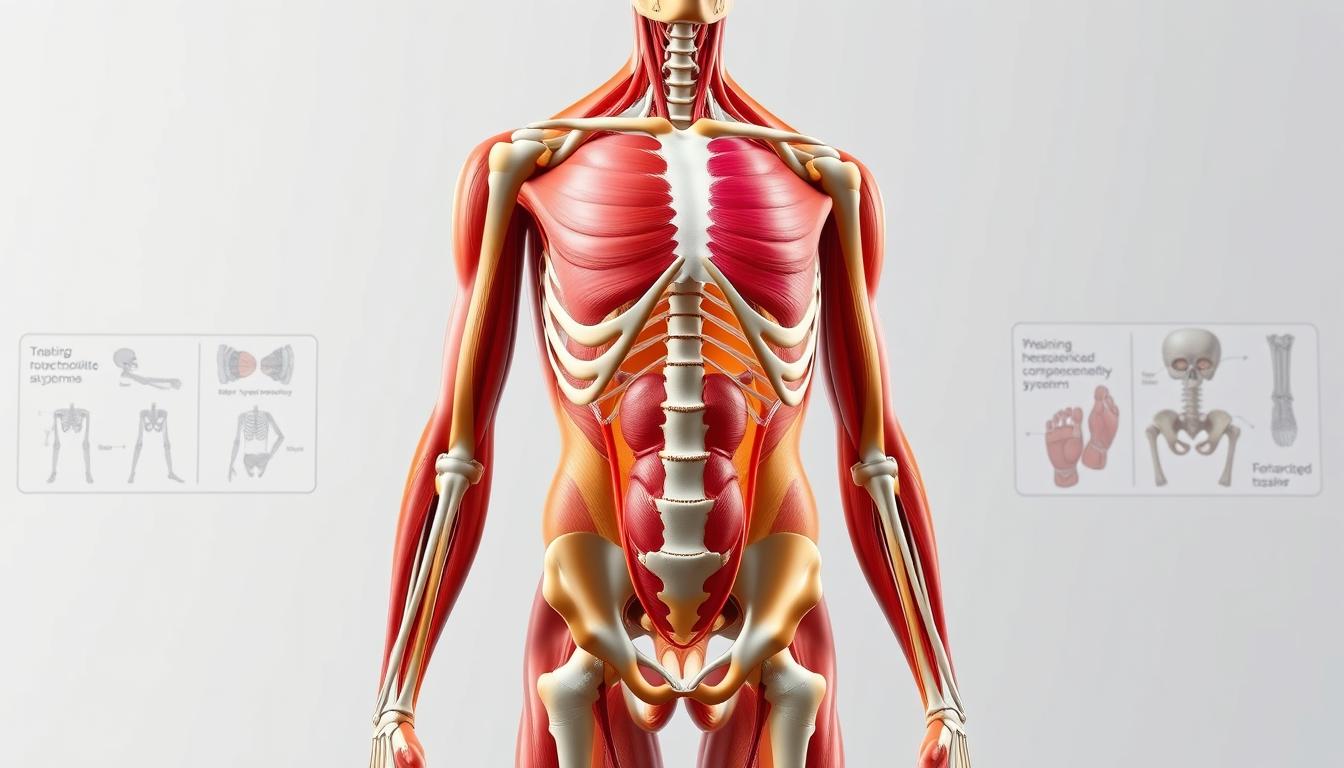
Neck muscles showed severe tightness, with bilateral suboccipital tension pulling the head forward. The atlas vertebra sat rotated right, while the axis bone tilted left. These misalignments compressed nerves and limited blood flow.
Mid-back findings proved equally striking. Three left ribs moved improperly during breathing, straining respiratory muscles. Lumbar vertebrae displayed rotational errors, creating uneven pressure on spinal discs.
| Region | Key Dysfunctions | Impact |
|---|---|---|
| Cervical | Rotated C1, hypertonic muscles | Headache risk |
| Thoracic | Rib 3-6 inhalation issues | Breathing strain |
| Lumbar | L4 rotation error | Hip instability |
OMT Techniques in Assessing Dysfunction
Practitioners used palpation to detect abnormal tissue texture. The right ankle showed ligament strain patterns needing counterstrain technique. Chapman’s points near the colon suggested digestive system involvement.
These findings guided treatment priorities. As one specialist noted: “Muscle tension patterns often reveal hidden compensation mechanisms in unstable joints.” This approach helps address root causes rather than isolated symptoms.
Treatment Protocols and Myofascial Release Techniques
Effective management of complex conditions demands precision. The patient’s protocol combined seven targeted methods addressing both structural and functional issues. Each session focused on restoring mobility while protecting vulnerable tissues.

Precision Pressure and Stabilization Methods
Clinicians began with suboccipital release to ease neck tension. Still’s technique realigned the head-neck junction by gently mobilizing the atlas and axis vertebrae. Soft tissue kneading followed, addressing tight areas from shoulders to hips.
For rib cage restrictions, practitioners used muscle energy techniques. Patients actively pushed against controlled resistance to reset joint positioning. “This approach lets your body guide the correction,” explains a certified osteopath. “We work with natural movement patterns.”
Dynamic Adjustments for Thoracic Challenges
High-velocity low-amplitude (HVLA) thrusts targeted stubborn rib inhalation issues. These quick, precise motions improved breathing mechanics within safe limits. Rotary methods addressed digestive concerns through abdominal fascia mobilization.
Ankle stability received attention via counterstrain positioning. By holding the foot in specific angles for 90 seconds, practitioners reduced ligament strain signals to the brain. This method avoids stressing already fragile connective tissues.
Progressive Treatment and Patient Responses
Tracking progress through multiple sessions reveals patterns invisible in single treatments. This patient’s journey shows how biological systems adapt—and resist—manual interventions over time.

Outcomes from the First Clinic Visit
The initial session delivered rapid results. Pain scores plunged from 5/10 to 2/10 within hours. “It felt like someone unclamped my ribs,” the patient reported, noting deeper breaths and smoother shoulder rotations.
Key improvements included:
- Expanded lung capacity during inhalation
- 45-degree increase in neck rotation range
- Reduced abdominal bloating post-treatment
Follow-Up and Symptom Improvement Details
Relief proved temporary but instructive. Symptoms resurged 48 hours later, though less intensely. At the second visit, elevated heart rate (106 bpm) and blood pressure (140/80 mmHg) hinted at stress responses. Yet pain again dropped sharply—this time to 1/10.
| Visit | Pre-Treatment Pain | Post-Treatment Pain | Relief Duration |
|---|---|---|---|
| 1 | 5/10 | 2/10 | 48 hours |
| 2 | 6/10 | 1/10 | 72 hours |
| 3 | 4/10 | 1/10 | 5 days |
Gastrointestinal changes emerged unexpectedly. The patient described “quieter digestion” and reduced constipation between sessions. This systemic response suggests manual therapy may influence autonomic nervous pathways beyond localized effects.
Myofascial Release & Ehlers-Danlos: Miracle or Misunderstood?
What if popular treatments rest on shaky scientific ground? Many therapists champion fascial work as revolutionary, yet struggle to explain how it helps. “We’re seeing results, but the why remains fuzzy,” admits a physical therapist specializing in connective tissue disorders.
Research reveals a troubling pattern. Over 1,200 studies mention fascia, yet fewer than 5% explore clinical applications. A 2023 analysis found:
“Therapists often cite microscopic fascial properties that lack proven therapeutic relevance.”
This gap fuels debates about mechanism versus outcome. Consider these common claims versus current evidence:
| Therapy Claim | Research Status | Clinical Relevance |
|---|---|---|
| “Releases fascial tension” | No measurement standard exists | Unproven |
| “Improves fluid dynamics” | Theoretical models only | Speculative |
| “Resets neural patterns” | Mixed evidence in pain studies | Possible placebo effect |
Does this mean fascial therapy doesn’t work? Not necessarily—but it challenges practitioners to separate biological facts from hopeful narratives. The EDS case study’s success might stem from improved circulation or reduced muscle guarding rather than direct fascial changes.
You deserve clear explanations, not just enthusiastic promises. As research evolves, so must our understanding of what hands-on therapies truly achieve.
Comparative Insights from Osteopathic Manipulative Treatment Studies
Medical breakthroughs often emerge where evidence meets real-world results. While formal studies on connective tissue disorders remain limited, emerging case reports reveal patterns worth exploring. This patient’s 60% pain reduction after three sessions highlights potential pathways for broader application.
Gaps and Discoveries in Existing Literature
Current research includes fewer than twelve documented OMT cases for similar conditions. Authors note most focus on single interventions rather than multi-session protocols. Our case aligns with 2021 findings showing improved respiratory function after fascial mobilization—but with longer-lasting effects.
A 2023 systematic review identified key challenges:
- Lack of standardized outcome measures across studies
- Limited tracking of autonomic nervous system responses
- Inconsistent documentation of symptom recurrence patterns
Transforming Observations Into Practice
These findings suggest manual treatment could complement traditional medicine for complex cases. However, authors stress the need for risk-adjusted approaches. Gentle techniques showing respiratory and digestive benefits may offer safer starting points than aggressive adjustments.
As Osteopathic Medicine journal editors recently stated: “Case reports should spark rigorous trials, not replace them.” Your care team can use these insights to weigh short-term relief against long-term evidence gaps—while advocating for more robust research.