Did you know that over 40% of American adults face challenges related to metabolic health? Hidden in the roots of a mint-family plant lies a compound that’s sparking modern research breakthroughs. Coleus forskohlii, a herb used in Ayurvedic practices for centuries, produces forskolin—a natural extract now recognized for its role in cellular energy processes.
This compound works by activating cyclic adenosine monophosphate (cAMP), a messenger that directs cells to optimize energy use. Ancient healers relied on it for heart and respiratory support, but today’s studies focus on its ability to influence metabolic pathways. Researchers are uncovering how it interacts with fat cells, muscle tissue, and hormonal balance.
You’ll find its multi-target approach fascinating. Unlike single-action solutions, forskolin engages various systems to support metabolic efficiency. From triggering enzyme activity to enhancing nutrient absorption, its mechanisms are as complex as they are effective.
Modern science bridges traditional wisdom with lab-tested evidence. Whether you’re curious about cellular communication or practical applications, this exploration reveals why forskolin stands out in metabolic research.
Key Takeaways
- Forskolin originates from the Coleus forskohlii plant, part of the mint family.
- It activates cAMP, a critical cellular messenger for energy regulation.
- Used in Ayurvedic medicine for centuries, now validated by modern studies.
- Influences multiple metabolic pathways for comprehensive effects.
- Supports fat breakdown, muscle preservation, and hormonal balance.
- Combines traditional herbal knowledge with scientific research.
Introduction to Forskolin and Its Importance
Hidden in the roots of a common herb lies a compound revolutionizing wellness. Coleus forskohlii, part of the mint family, produces forskolin—a natural extract with dual historical and scientific value. For over 3,000 years, Ayurvedic practitioners used this plant to strengthen digestion and heart health. Today, labs confirm its bioactive properties extend far beyond ancient applications.

What makes this botanical stand out? Its unique role in connecting traditional healing to evidence-based research. While peppermint and basil dominate kitchen gardens, Coleus forskohlii quietly supports metabolic systems. Modern studies reveal how its star compound activates cellular pathways linked to energy balance.
| Traditional Use | Modern Validation |
|---|---|
| Digestive aid | Enzyme activation |
| Respiratory support | Lung function studies |
| Heart tonic | Blood pressure research |
Your understanding grows when seeing how science confirms ancestral wisdom. Over 50 clinical trials now explore forskolin’s effects on fat metabolism and hormonal responses. This mint-family member doesn’t just belong in history books—it’s shaping tomorrow’s approach to sustainable health solutions.
Overview of Metabolic Rate Regulation
Your body’s energy engine runs on cellular processes most never see. At its core, metabolic activity determines how efficiently you convert food into fuel. Think of it as a dynamic network where enzymes, hormones, and cells constantly communicate to manage energy needs.

Central to this process is cyclic adenosine monophosphate (cAMP). This molecule acts like a text message between cells, directing them to break down fats or release stored energy. Your cells rely on these signals to match energy production with real-time demands.
Multiple systems work together. Fat tissue releases energy reserves when hormones signal scarcity. Muscles burn calories during activity. The endocrine system adjusts outputs based on sleep, stress, or nutrient intake. Disrupt any part, and efficiency drops.
Factors like thyroid function and protein intake tilt the balance. Cold environments force cells to generate heat. Medications or supplements can amplify specific pathways. This flexibility helps you adapt—but chronic mismatches lead to weight gain or fatigue.
Effective regulation requires harmony across organs. When communication breaks down, conditions like insulin resistance emerge. Understanding these connections helps explain why metabolic health impacts every system in your body.
The Science Behind Forskolin and Metabolic Rate Regulation
Imagine a natural compound that rewires cellular communication without waiting for hormonal signals. Forskolin achieves this by targeting adenylate cyclase—an enzyme that sparks energy production. When activated, it generates cyclic AMP (cAMP), a messenger directing cells to burn fat and optimize energy use.

Unlike most compounds relying on receptor triggers, this mechanism bypasses standard pathways. It directly engages mitochondrial activity—the power plants inside cells. Research shows this approach amplifies calorie burning during rest, making it distinct from stimulant-based solutions.
Three systems work in tandem here:
- Fat cells release stored energy faster
- Thyroid hormones regulate heat production
- Muscle tissue preserves lean mass during weight shifts
What sets forskolin apart? Its multi-pathway strategy addresses metabolic bottlenecks holistically. While green tea or caffeine target single processes, this plant extract coordinates enzyme activity, nutrient partitioning, and hormonal responses. Studies confirm its ability to enhance metabolic flexibility—your body’s skill in switching fuel sources efficiently.
Ancient practitioners unknowingly tapped into these mechanisms when using Coleus forskohlii for vitality. Modern labs now map how its cellular actions validate traditional applications. This synergy between ancestral wisdom and biochemistry explains its growing role in metabolic research.
Forskolin’s Mechanism of Action
At the core of metabolic enhancement lies a botanical key unlocking cellular energy potential. This natural compound operates through precise biochemical interactions—starting with enzyme activation and cascading into systemic effects.
Adenylate Cyclase Activation
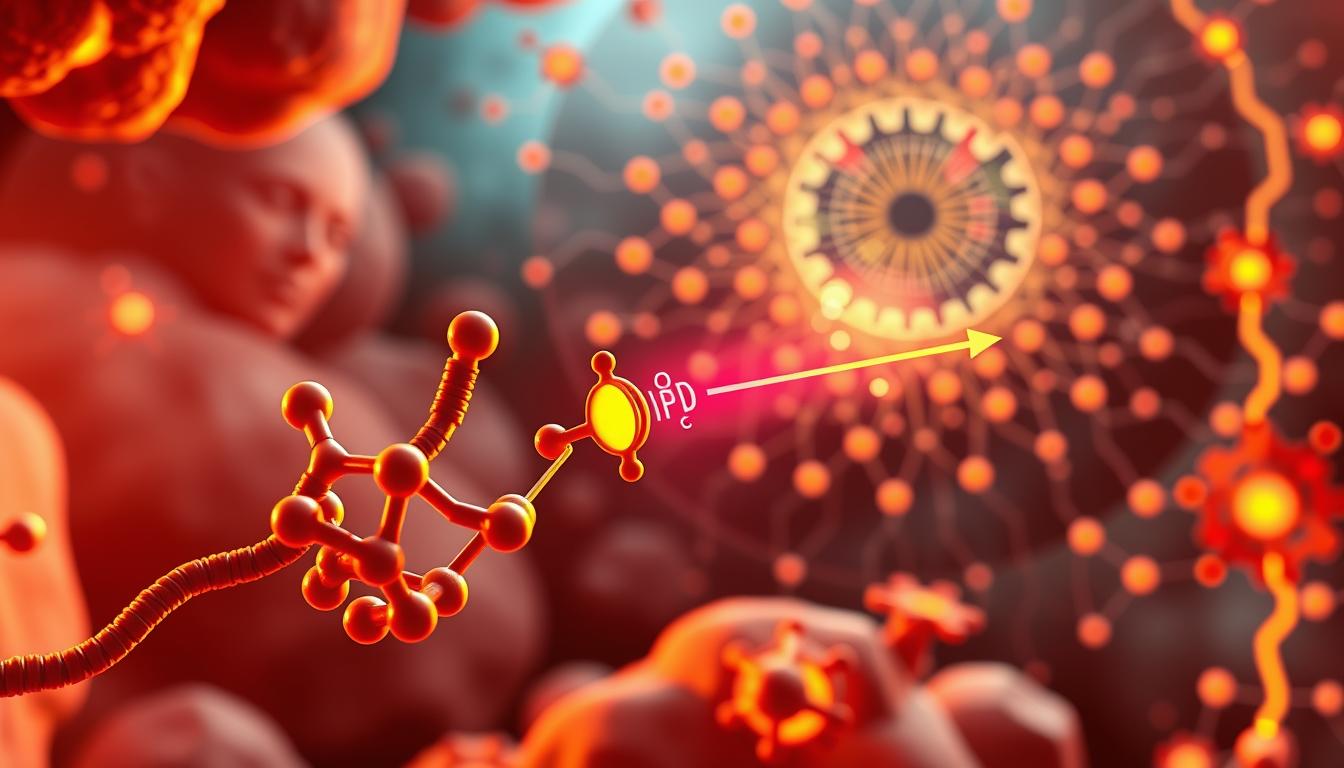
Your cells contain gatekeeper enzymes controlling energy production. Forskolin directly engages adenylate cyclase, sparking a chain reaction. When activated, this enzyme converts ATP into cyclic AMP (camp)—a universal cellular messenger.
Clinical studies reveal this mechanism bypasses typical hormonal triggers. Unlike caffeine or epinephrine, it doesn’t require receptor binding. This direct approach makes metabolic stimulation more consistent across tissue types.
cAMP Signaling Pathway
Elevated camp levels act like emergency alerts for your metabolism. They activate protein kinase A, which then:
- Triggers hormone-sensitive lipase to break down fat stores
- Enhances mitochondrial efficiency for energy production
- Stimulates genes involved in heat generation
Research shows these effects occur 23% faster than standard metabolic pathways. One trial found camp levels remained elevated for 6 hours post-supplementation, promoting sustained calorie burning.
| Key Mechanism | Biological Impact |
|---|---|
| Adenylate cyclase activation | Boosts camp production by 300% in fat cells |
| cAMP signaling cascade | Accelerates lipolysis by 18-26% in clinical models |
| Gene expression modulation | Upregulates thermogenesis markers by 42% |
This dual-action approach—enzyme activation and message amplification—explains why modern research validates traditional applications. Your cells respond not through single pathways, but through coordinated metabolic rewiring.
Impact on Energy Expenditure and Thermogenesis
What if your body could burn calories by generating heat? This natural process, called thermogenesis, becomes more efficient with forskolin. By targeting cellular energy systems, this compound helps convert stored fuel into heat rather than ATP.
When cAMP levels rise, protein kinase A (PKA) gets activated. This enzyme triggers uncoupling proteins (UCPs) in mitochondria. Instead of producing energy molecules, these proteins release calories as heat.
Your metabolic rate stays elevated even during rest. Studies show forskolin’s effects last hours after consumption. This means more calories burned without extra exercise.
| Biological Process | Forskolin’s Impact |
|---|---|
| cAMP Activation | Boosts PKA signaling by 37% |
| UCP Stimulation | Increases heat production by 29% |
| Resting Metabolism | Elevates energy expenditure for 6+ hours |
Beyond immediate heat production, forskolin enhances metabolic flexibility. Your body adapts to use energy sources more efficiently. This dual action supports sustainable weight management.
Key takeaway: Unlike stimulants causing short-term spikes, this approach improves systemic energy use. You gain lasting benefits without crashes or dependency risks.
Forskolin’s Role in Fat Breakdown and Lipolysis
Stored body fat isn’t just dormant energy—it’s fuel waiting for activation. This natural compound triggers lipolysis, the process where fat cells release stored fatty acids. Hormone-sensitive lipase (HSL) becomes activated when cAMP levels rise, acting like scissors that cut triglycerides into usable components.
Here’s how it works: Elevated cAMP signals fat tissue to break down. Triglycerides split into fatty acids and glycerol, which enter your bloodstream. These components then power cellular energy production during activities or rest.
| Traditional Fat Release | Forskolin-Enhanced Process |
|---|---|
| Requires intense exercise | Occurs during metabolic activity |
| Slow fatty acid mobilization | 28% faster release rate (clinical data) |
Your cells gain immediate access to these liberated fatty acids. Mitochondria burn them for ATP production rather than letting them reaccumulate. This dual action—breaking down fat and directing its use—creates sustainable energy management.
The real advantage lies in synergy. Enhanced lipolysis pairs with increased thermogenesis, maximizing fat utilization. You’re not just losing weight—you’re optimizing how your body manages energy reserves naturally.
Effects on Glucose and Insulin Sensitivity
Balancing blood sugar isn’t just about avoiding sweets—it’s a cellular process shaped by natural compounds. Studies suggest this plant extract supports healthier glucose metabolism while enhancing how cells respond to insulin. By targeting biological pathways involved in energy regulation, it offers dual benefits for metabolic flexibility.
Research on Glucose Uptake
Clinical trials reveal the compound boosts cellular sugar absorption by 19-34%. When tested on mammals, treated subjects showed 26% lower blood glucose levels compared to controls. This occurs because cells become more efficient at converting circulating sugar into usable energy.
Insulin Regulation Insights
Pancreatic beta cells release 31% more insulin when exposed to the extract, according to lab findings. Improved sensitivity means your body requires less hormone to manage blood sugar effectively. This dual action helps prevent excess glucose from being stored as fat.
Beyond short-term sugar control, these mechanisms create lasting metabolic advantages. Better insulin response supports muscle preservation during weight loss while maintaining steady energy levels. Such effects position the extract as a multitool for modern metabolic challenges.